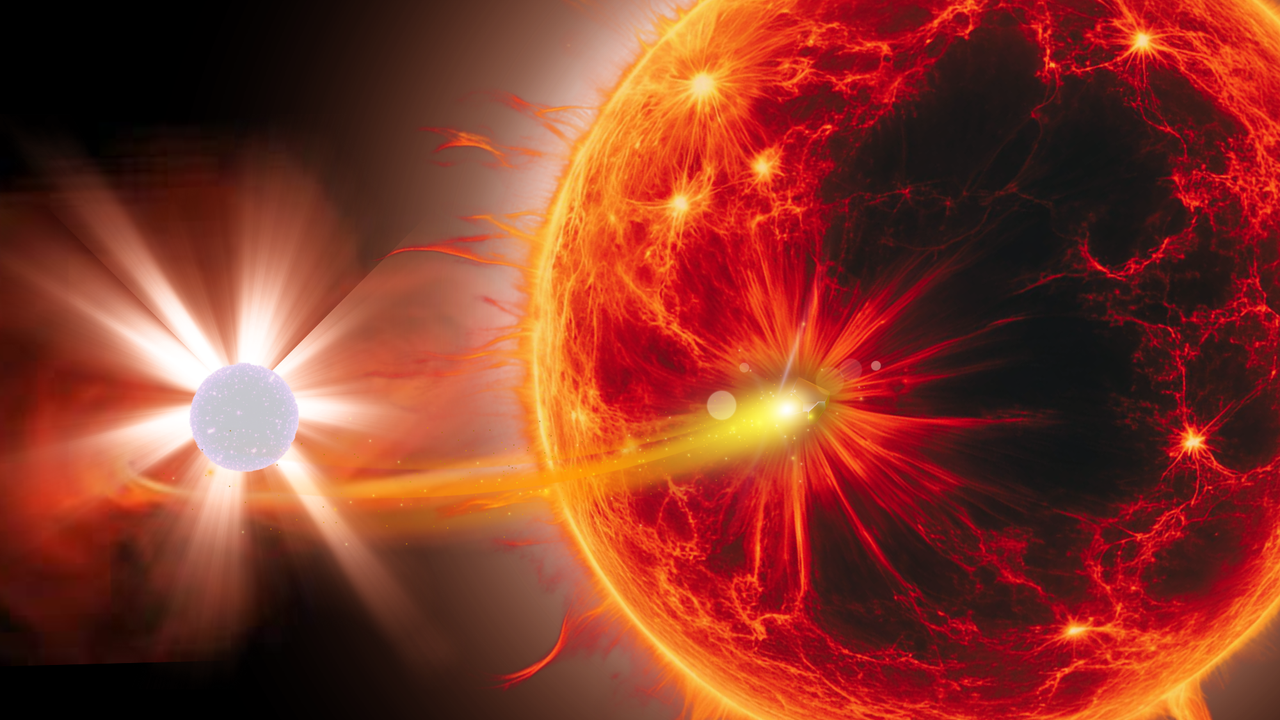
Astronomers analyzing nearly 3,000 Type Ia supernovae have found evidence that dark energy, the mysterious force driving the universe's accelerating expansion, is not constant but evolving across cosmic time. This discovery challenges the standard cosmological model and opens new questions about the fundamental nature of the universe.
Type Ia supernovae occur when white dwarfs, the dense remnants of dead stars, strip material from companion stars until they become unstable and explode. These explosions serve as "standard candles" in astronomy, objects with known brightness that allow scientists to measure distances across the universe. In 1998, observations of Type Ia supernovae led to the Nobel Prize-winning discovery that the universe's expansion is accelerating, a phenomenon attributed to dark energy.
The new analysis, drawing from a catalog of nearly 3,000 white dwarf explosions, suggests dark energy's strength varies with cosmic time rather than remaining static as Einstein's cosmological constant predicts. If confirmed, this would reshape fundamental physics and force a complete rethinking of the universe's composition and fate.
Scientists typically assume dark energy accounts for approximately 68 percent of the universe's total mass-energy content, with dark matter comprising another 27 percent and ordinary matter just 5 percent. A varying dark energy would mean the universe's expansion rate has changed throughout history in ways currently unexpected. The research carries profound implications. If dark energy weakens over time, the universe might eventually stop accelerating and recollapse. If it strengthens, expansion could accelerate toward a "Big Rip" scenario where all structures tear apart.
The study leverages improved supernova data and refined measurement techniques developed over the past two decades. Instruments like the Hubble Space Telescope and ground-based observatories have cataloged Type Ia events across billions of years of cosmic history, creating a timeline of the universe's expansion. Analyzing such a large sample reduces statistical noise and reveals patterns invisible in smaller datasets.
This research aligns with other recent tensions in cosmology. The Hubble tension, a disagreement between measurements of the universe's expansion rate using different methods, suggests the standard model may be incomplete. A evolving dark energy could potentially reconcile these conflicting measurements.
Next steps involve obtaining spectroscopic data on additional supernovae and cross-referencing findings with other probes of dark energy, including baryon acoustic oscillations in galaxy distributions and gravitational lensing observations. The James Webb Space Telescope and future observatories will detect more distant supernovae, extending the cosmic timeline and testing whether the evolution pattern holds.
The implications reach beyond astronomy. If dark energy truly evolves, it points toward new physics beyond general relativity. Theoretical models invoking quintessence fields, modified gravity theories, or other exotic physics could explain the observations. This discovery underscores how precision measurements of distant explosions continue to unlock the universe's deepest secrets and reveal that the cosmos operates far differently than anyone expected.