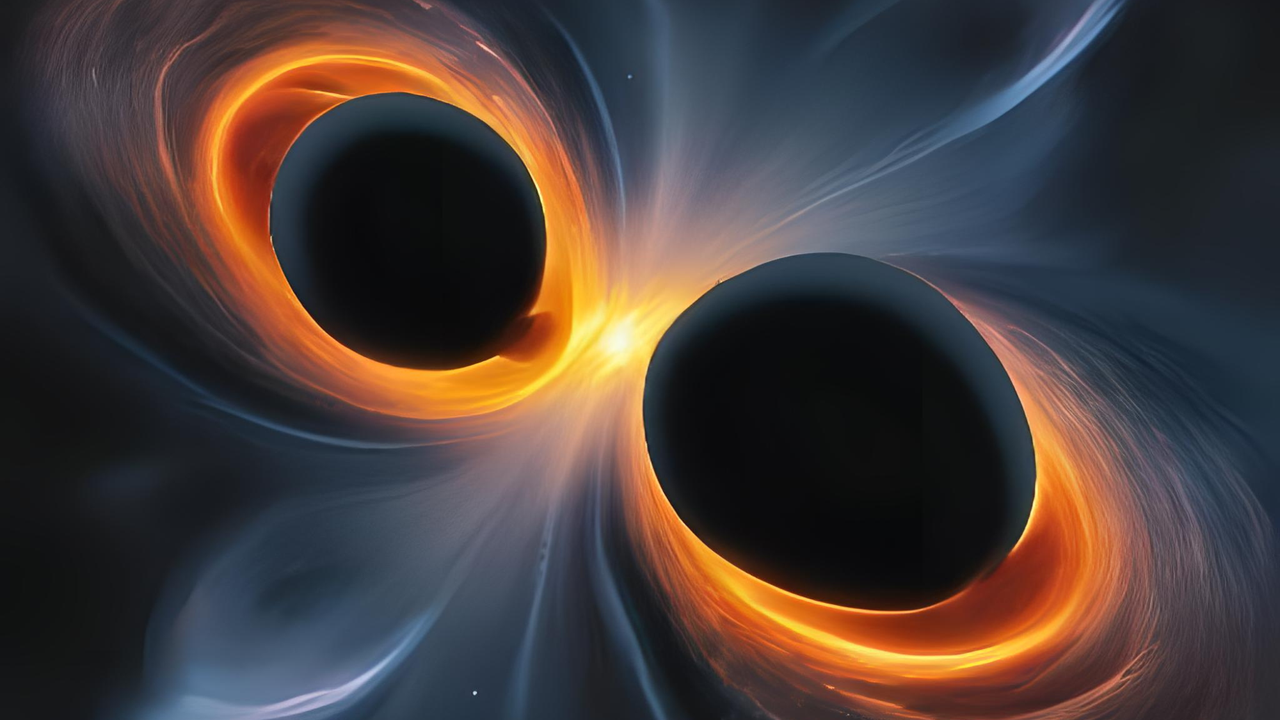
Astronomers have long believed certain black hole mergers should not happen. A new analysis reveals how one of these "forbidden" events might actually occur through previously underestimated gravitational dynamics.
The merger in question defies conventional understanding of black hole interactions. When two black holes orbit each other, conservation of energy and angular momentum normally prevents mergers between objects of vastly different masses. The smaller black hole should radiate away orbital energy through gravitational waves and spiral inward, but the process faces theoretical constraints that make extreme mass-ratio mergers appear impossible within reasonable timeframes.
Researchers now propose that the black holes involved in this merger were smaller than initial estimates suggested. This recharacterization changes the mass ratio between the two objects, bringing the event into the realm of the possible. The study examines gravitational wave data and the orbital dynamics that preceded the merger, recalculating the properties of each black hole by accounting for subtleties in how spacetime itself warps around merging objects.
A warp in spacetime creates an asymmetry in how gravitational waves propagate outward. This asymmetry, called orbital precession, means the black holes do not follow perfectly circular or elliptical paths. Instead, their orbits shift gradually as they lose energy to radiation. When researchers incorporate this precession into their models more carefully, the calculated masses of the merging black holes shift downward. The revised masses fall within parameters that allow the merger to occur through known physical processes.
This finding has direct implications for LIGO and Virgo, the gravitational wave observatories that detected mergers previously classified as anomalous. The Advanced LIGO detector in the United States and the Advanced Virgo detector in Italy have logged hundreds of black hole collisions since 2015. Many of these events produced unexpected results that challenged theorists. Some mergers involved black holes larger than stellar physics predicts should exist. Others paired objects with mass ratios that seemed to violate fundamental conservation laws.
The new research suggests that recalibration of data analysis techniques could explain several of these anomalies. By accounting for relativistic effects more precisely during the merger itself, astronomers can extract more accurate mass estimates from the gravitational wave signals. This approach does not require exotic physics or new particle types. The universe operates through standard general relativity, but the full complexity of that theory requires careful mathematical treatment.
The implications extend beyond resolving past mysteries. Future observations from the Laser Interferometer Gravitational-Wave Observatory and its international partners will benefit from these refined analysis methods. Upgrades to LIGO and the planned Einstein Telescope in Europe will detect even fainter signals from more distant mergers, expanding the catalog of black hole collisions available for study. More precise mass measurements will sharpen our understanding of how black holes form, grow, and interact across cosmic time.
This work demonstrates how gravitational wave astronomy continues to reveal new details about the universe's most violent events. What appeared forbidden now appears merely rare, governed by relativistic physics that researchers are still learning to measure with full accuracy.