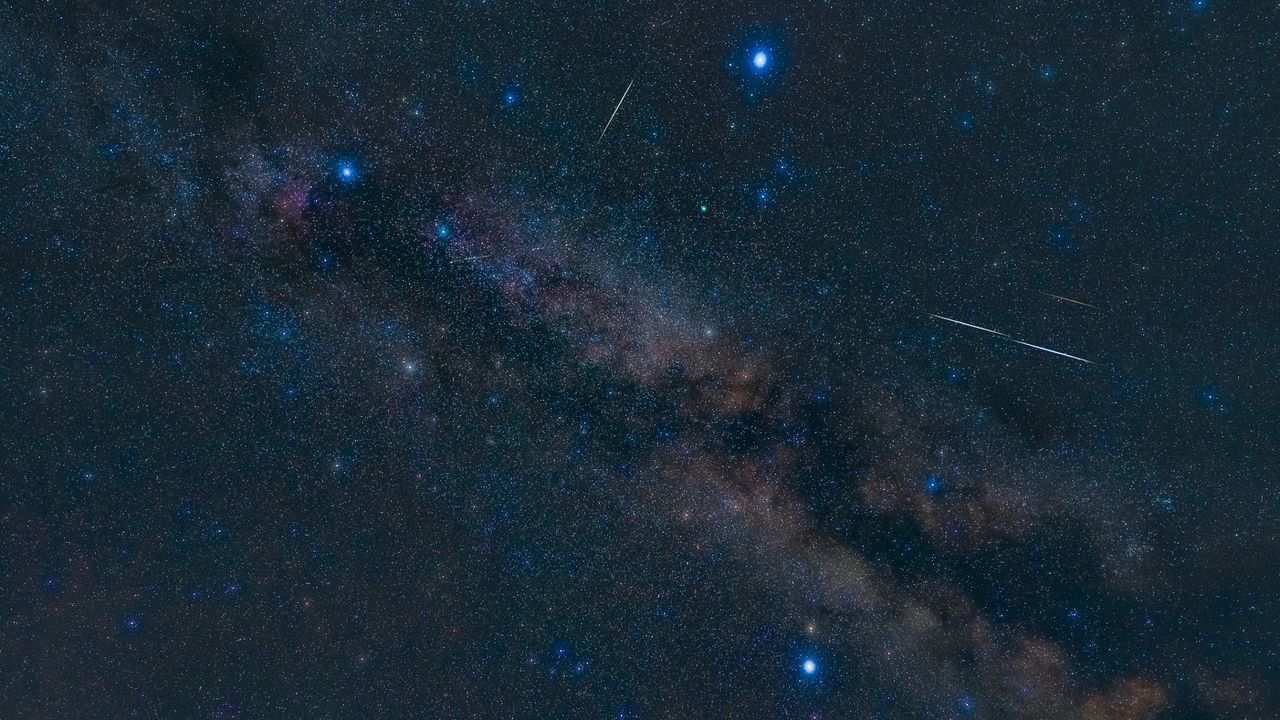
The Summer Triangle stands as one of the most recognizable asterisms in the night sky, yet its seasonal appearance involves more than simple calendar timing. Three first-magnitude stars, Vega, Altair, and Deneb, form this triangle that dominates northern hemisphere skies from June through October, even as autumn advances and temperatures drop.
Vega anchors the western vertex of the triangle. Located 25 light-years from Earth in the constellation Lyra, this brilliant blue star ranks as the fifth brightest star visible from our planet. Altair occupies the southern point, sitting 17 light-years away in Aquila. Deneb completes the formation from the north in Cygnus, though this supergiant star resides roughly 2,600 light-years distant, making it intrinsically far more luminous than its companions despite appearing only slightly brighter than Vega and Altair.
The triangle persists well into autumn because the celestial mechanics behind its visibility span several months. These stars reach their highest positions above the horizon during summer evenings, making them easy to spot during twilight hours when most observers begin their stargazing. As Earth orbits the sun, the apparent rotation of the celestial sphere shifts the triangle's position, but these stars remain well-positioned throughout late summer and fall. Not until November do they begin setting earlier in the evening, finally yielding dominance to winter constellations.
The seasonal mystery surrounding the Summer Triangle lies partly in human observation patterns. Summer invites more casual stargazers outdoors, creating a cultural connection between warm weather and this particular celestial feature. Once people learn to locate the triangle, they continue tracking it through autumn, reinforcing its association with the season of its discovery rather than its actual visibility window.
Each star in the triangle tells different stories about stellar evolution. Vega spins so rapidly that its equator bulges outward, deforming its spherical shape. Deneb, a blue supergiant, burns through its fuel at a frantic pace and likely has only a few million years remaining before it explodes as a supernova. Altair, meanwhile, represents a younger, more sedate star, though still hot and blue compared to our sun.
The Summer Triangle serves practical purposes for navigation. Locating these three bright stars helps observers orient themselves to other constellations and deep-sky objects. The Milky Way runs directly through this region, passing closest to the sky near Deneb and Altair. Amateur astronomers often use the triangle as a gateway to exploring planetary nebulae, open clusters, and star fields embedded within Cygnus and Aquila.
Understanding why seasonal asterisms persist beyond their apparent peak season illuminates how our planet's motion interacts with stellar positions. The Summer Triangle continues dominating evening skies well into autumn not because of any change in the stars themselves, but because of the slow, predictable waltz between Earth's orbit and the background cosmos. This dance ensures that summer's greatest stellar fixture remains visible long after the season that gave it its name.