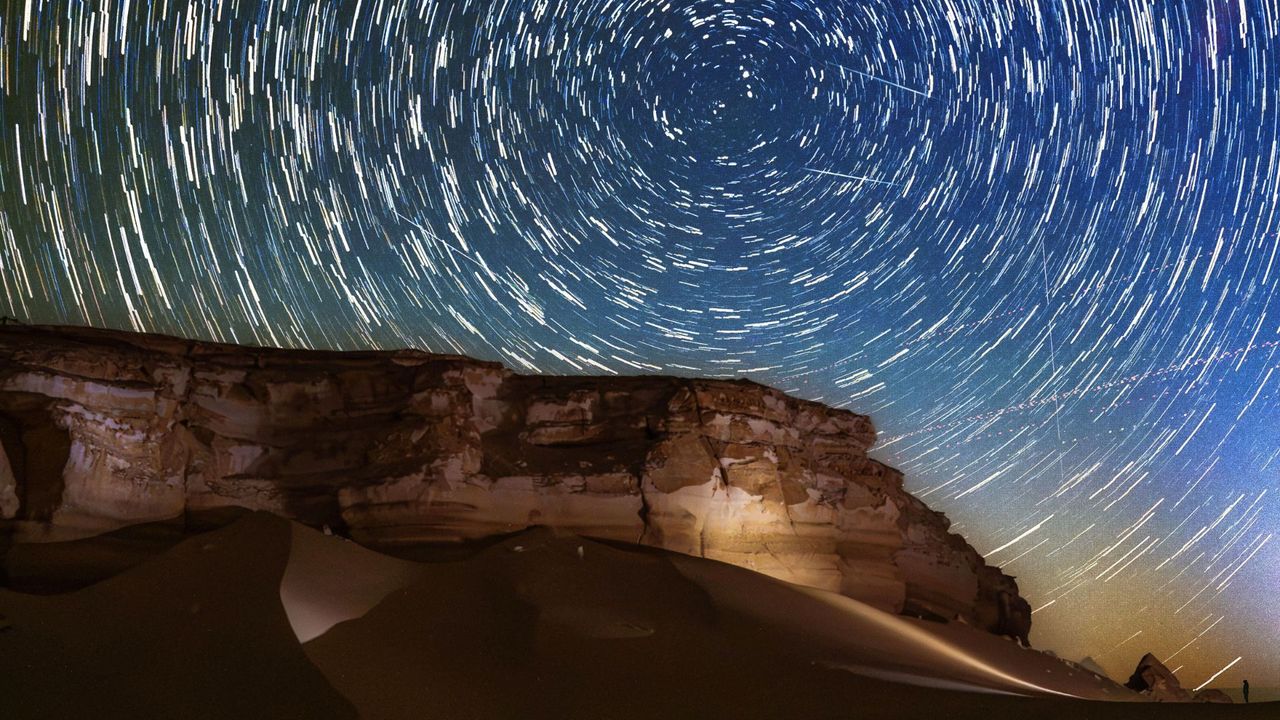
Photographer Osama Fathi documented a rare celestial convergence over Egypt's Western Desert during the peak of the Perseid meteor shower on August 13-14. His image captures meteor streaks intersecting with star trails, creating a layered view of Earth's motion through space and the debris field of Comet Swift-Tuttle.
The Perseid meteor shower ranks among the year's most reliable and prolific meteor events. Earth passes through the comet's orbital debris trail every August, with peak activity typically lasting several nights. During optimal conditions, observers can spot 50 to 100 meteors per hour under dark skies. The meteors enter the atmosphere at approximately 132,000 miles per hour, ionizing air molecules and producing the characteristic bright streaks visible from the ground.
Fathi's photograph captures both phenomena simultaneously. Star trails appear when long-exposure camera settings track the Earth's rotation against the background stars, creating circular arcs across the frame. Superimposing Perseid meteors atop these trails required precise timing, patience, and access to minimal light pollution. Egypt's Western Desert provides ideal conditions for astronomical observation, with vast expanses of sand and rock offering unobstructed views of the night sky.
The photographic technique reveals fundamental principles of celestial mechanics. The star trails document Earth's 24-hour rotation about its axis. The meteor streaks mark the moment Swift-Tuttle's icy debris particles collide with the thermosphere, typically between 50 and 80 kilometers altitude. Unlike stars, which remain fixed in position relative to distant objects, meteors occupy only milliseconds of the night sky before burning away.
Comet Swift-Tuttle last reached perihelion in 1992 and will return in 2126. The debris stream persists long after the comet's passage, creating annual meteor showers along Earth's orbital path. Astronomers track Perseid activity to monitor changes in comet activity and the distribution of interplanetary dust. Changes in meteor frequency or brightness can indicate shifts in the debris field's density or composition.
Astrophotography from remote locations like the Western Desert contributes valuable documentation of meteor shower activity. Citizen science efforts help professional astronomers map meteor radiant points, estimate meteoroid sizes, and track long-term shower trends. Images like Fathi's provide both scientific data and public engagement with fundamental astronomy.
The Perseids occur near Perseus, the radiant point from which meteors appear to originate. This optical effect results from Earth's perspective as the planet plows through the debris stream at 37 miles per second. Observers in the Northern Hemisphere and mid-southern latitudes see the best displays, though the shower remains visible across much of the globe.
August's combination of warm weather, reliable meteor activity, and extended twilight windows makes the Perseid shower ideal for public observation. Fathi's image demonstrates that even smartphone cameras and entry-level equipment can capture the shower's beauty when combined with dark skies and creative composition. The photograph stands as documentation of both a celestial event and Earth's place within the solar system's dynamic environment.