# Comet NEOWISE Captures the Adriatic Sky in September 2026
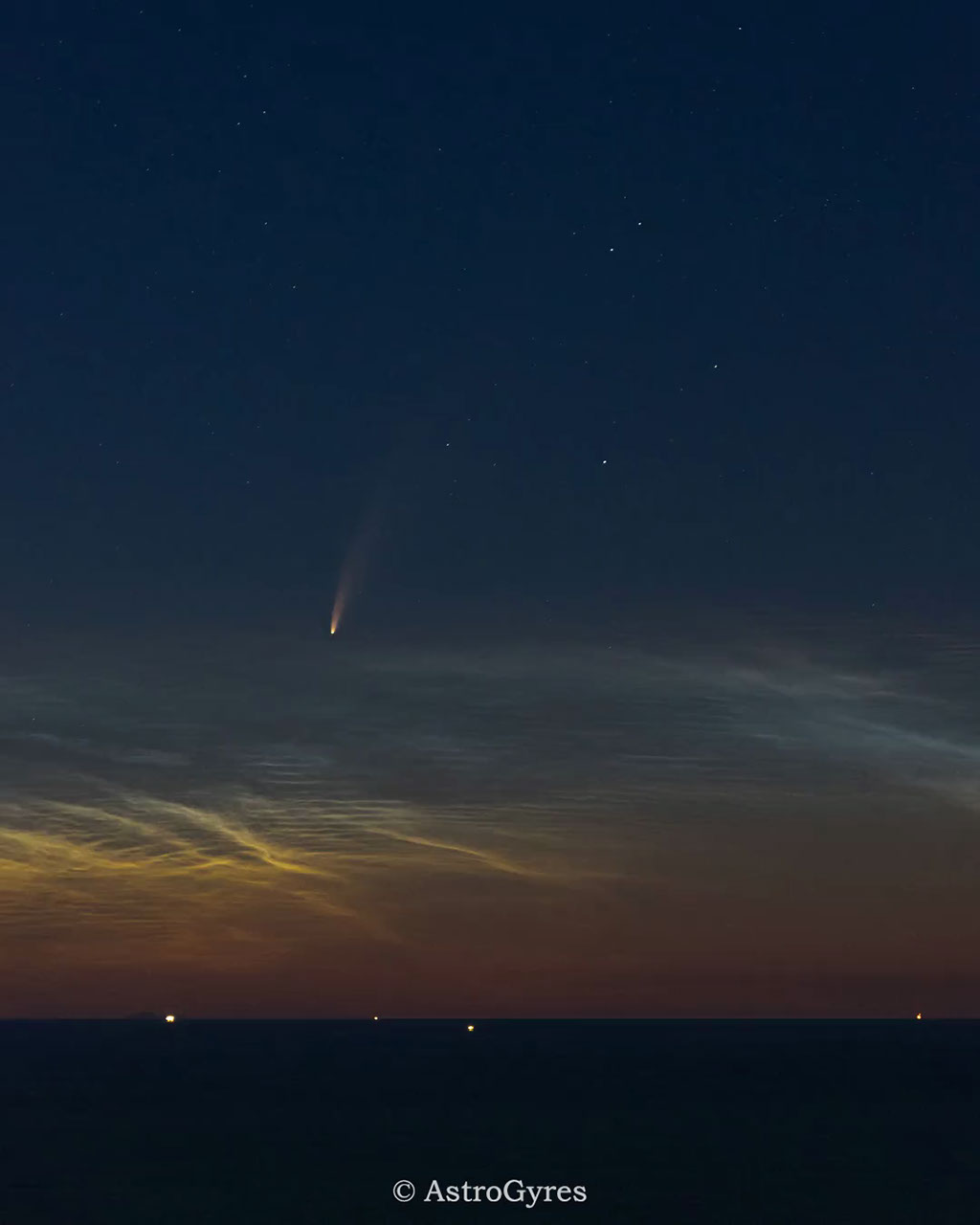
NASA's Astronomy Picture of the Day featured a striking image of Comet NEOWISE rising above the Adriatic Sea, captured during September 2026. The photograph documents one of the year's most accessible naked-eye comets during a particularly favorable viewing window, when the object climbed higher into evening skies above southern Europe.
Comet NEOWISE, officially designated C/2020 F3, became one of the brightest comets visible from Earth in over two decades after its discovery by NASA's Near-Earth Object Wide-field Infrared Survey Explorer (NEOWISE) space telescope in March 2020. The comet reached peak brightness during July 2020, dazzling observers across both Northern and Southern hemispheres with its distinctive greenish coma and long dust tail. The September 2026 observation represents a return appearance as the comet continued its orbit through the inner solar system.
The image captures the comet low on the horizon, with its tail extending upward into the darkening sky. This geometric perspective, where observers view the comet rising against the backdrop of the Mediterranean, creates dramatic compositional depth. The Adriatic location provided optimal viewing conditions, with minimal light pollution from nearby coastal settlements and favorable atmospheric transparency over water.
Comets become visible to the naked eye when solar radiation heats their icy nuclei, releasing gases and dust that form the characteristic coma and tail. The coma appears green because diatomic carbon molecules fluoresce under ultraviolet light from the Sun. The dust tail reflects sunlight directly, while the ion tail streams away from the Sun due to solar wind pressure, often appearing bluish in photographs.
NEOWISE's discovery by the infrared space telescope reflects NASA's systematic approach to identifying potentially hazardous near-Earth objects. The mission scans the sky repeatedly, allowing astronomers to detect faint comets and asteroids that might otherwise remain unknown. When NEOWISE identified this comet in 2020, it possessed sufficient brightness at great distance to warrant close monitoring and public observation alerts.
Tracking Comet NEOWISE's return appearances provides astronomers with valuable orbital data. Precise positional measurements from multiple observations help refine the comet's trajectory and predict future visibility windows. Such data feeds into NASA's Planetary Defense Coordination Office, which maintains catalogs of near-Earth objects and assesses impact risks across centuries of predicted orbital motion.
The September 2026 sighting demonstrates how comets remain accessible to amateur astronomers and the general public. Unlike exoplanet detection or gravitational wave observation, comet watching requires only dark skies and patience. Observers across the Mediterranean region documented the event through photographs and sketches, contributing observations to the International Astronomical Union's Minor Planet Center, which maintains the authoritative database of comet positions and brightness measurements.
Professional astronomers used the 2026 apparition to obtain spectroscopic data, measuring the composition of the comet's outgassing through light analysis. Such observations reveal the chemical makeup of material preserved since the solar system's formation 4.6 billion years ago. Each comet visit offers a fresh sample of pristine icy material, providing windows into the conditions that existed when planets formed from the primordial solar nebula.