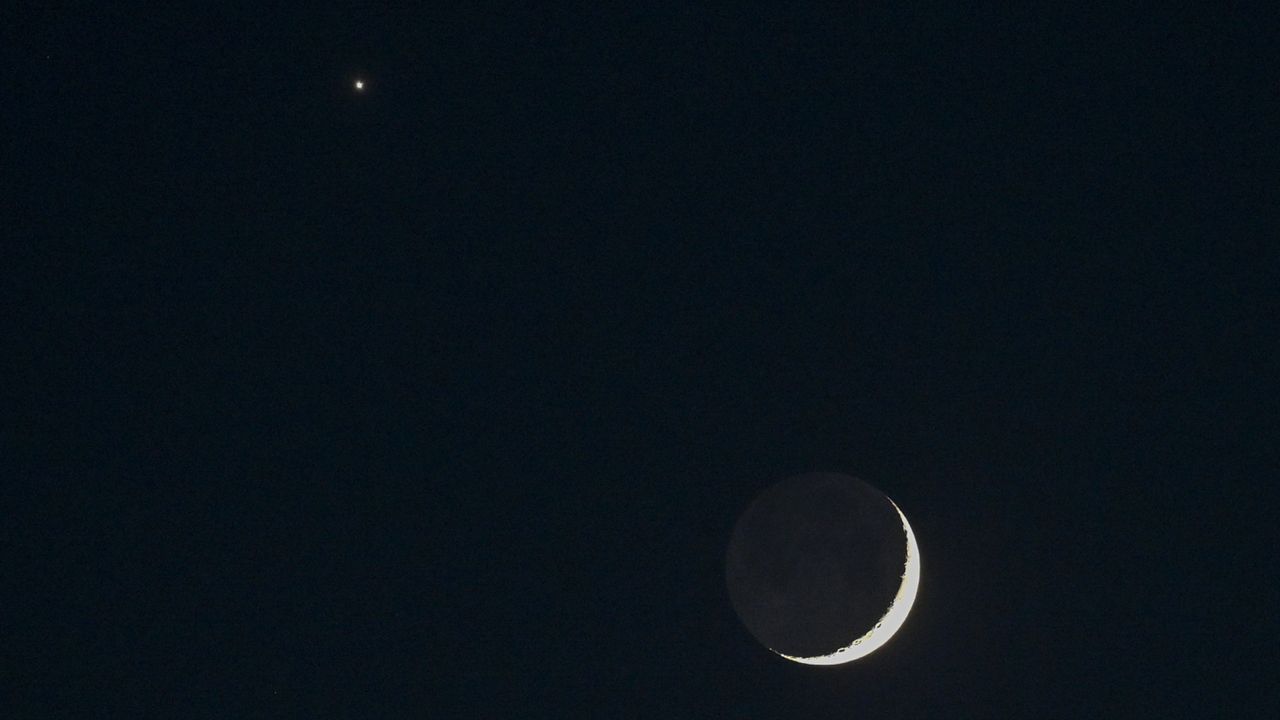
Venus reaches its peak brilliance in Earth's night sky tonight as the brightest planet appears within a few degrees of a waxing crescent moon at sunset on September 13. Observers across most of the globe will witness this conjunction with naked eyes, requiring no telescopes or binoculars to catch the spectacle.
Venus dominates Earth's skies as the second planet from the sun, and its proximity to our world makes it the brightest natural object in the night sky after the moon itself. Tonight's close approach to the lunar crescent creates an ideal viewing opportunity for stargazers of all experience levels. The two bodies will share the same patch of western sky shortly after sunset, with Venus appearing as an unmistakable bright point near the moon's slender crescent curve.
The timing matters for observation. Viewers should position themselves with a clear view of the western horizon roughly 30 to 45 minutes after local sunset. Venus reflects sunlight with extraordinary efficiency due to its thick atmosphere of carbon dioxide and clouds of sulfuric acid. This reflective quality, combined with the planet's relatively close orbital position to Earth at this time, creates the intense luminosity that makes Venus visible even in twilight conditions when fainter stars remain hidden.
The waxing crescent moon, growing from new toward full, provides an elegant backdrop for tonight's sight. The moon's slender curve will frame Venus as it climbs away from the sun's glare. Photography enthusiasts should note that the contrast between the dark moon and bright Venus offers compelling composition opportunities. Standard smartphone cameras can capture the scene with minimal effort, though longer exposures and manual focus settings improve results.
Venus reaches such favorable evening positions roughly every 584 days, a cycle determined by the planet's orbital period relative to Earth. During these evening apparitions, Venus sometimes appears as the "Evening Star," a name that has drawn human attention for millennia. Ancient astronomers tracked Venus with precision, and various cultures embedded the planet's movements into their calendars and mythologies.
Tonight's conjunction serves as a reminder that naked-eye astronomy connects us directly to the cosmos without instrumentation or expense. The moon and Venus have aligned in Earth's sky countless times throughout human history. Medieval scholars studied these conjunctions. Renaissance astronomers used them to test new theories of planetary motion. Modern observers continue this unbroken tradition of looking upward.
Clear skies will be essential for optimal viewing. Cloud cover in your region may obscure the event, but the conjunction will remain valid for several nights as the moon and Venus maintain proximity. Tomorrow evening and the following nights will present similar opportunities if clouds interfere with tonight's observation.
Set aside 10 minutes at sunset to step outside and look west. Venus and the crescent moon offer a free display of planetary mechanics and celestial beauty, accessible from anywhere on Earth with an unobstructed western horizon.