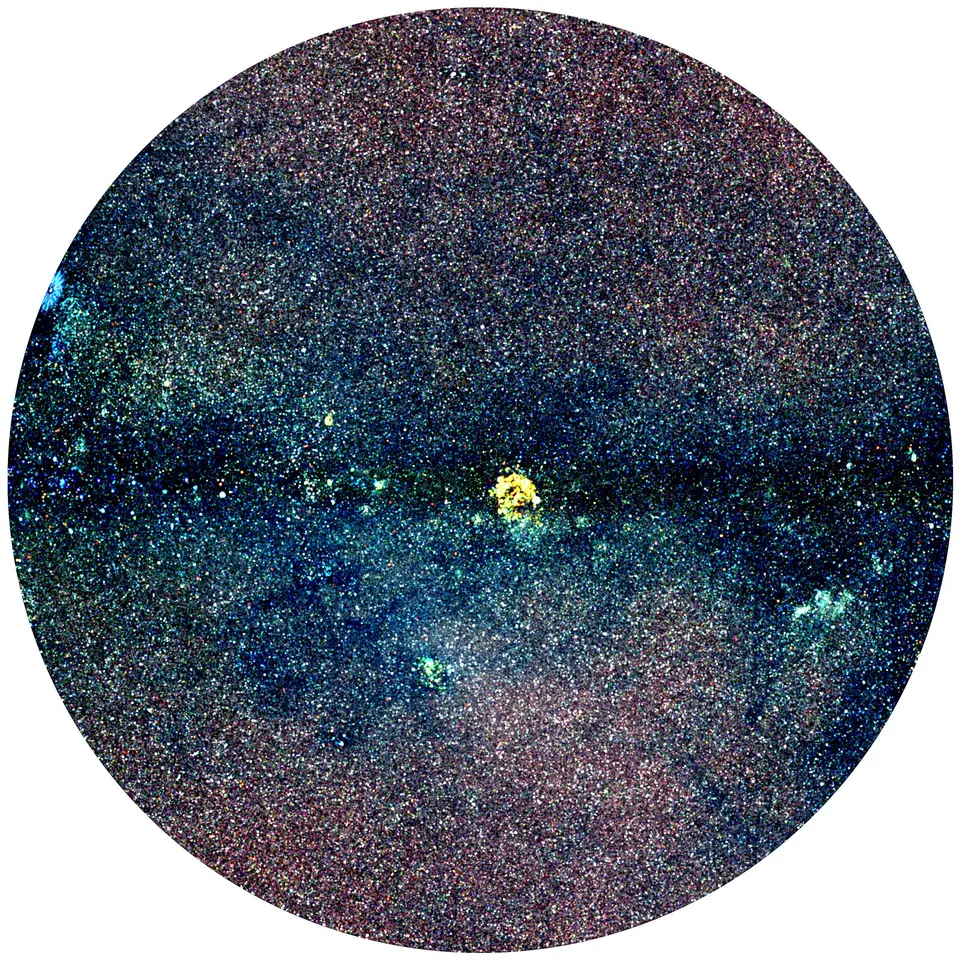
The eROSITA X-ray telescope has released its second data catalog, expanding the known population of high-energy sources in the cosmos to two million objects. This represents a near doubling of the previous catalog and marks the most comprehensive X-ray census of the universe assembled to date.
eROSITA, the Extended ROentgen Survey with an Imaging Telescope Array, launched aboard Russia's Spektrum-Roentgen-Gamma spacecraft in July 2019. The German-led instrument operates from the second Lagrange point, roughly 1.5 million kilometers from Earth, where it conducts all-sky surveys in the soft and hard X-ray bands. The telescope's unique design uses seven aligned mirror modules to detect high-energy photons across wavelengths from 0.3 to 10 keV.
The second data release incorporates observations spanning the instrument's all-sky survey phase. eROSITA scans the entire celestial sphere repeatedly, building sensitivity with each pass. The DR2 catalog aggregates data from multiple survey rotations, creating unprecedented depth across X-ray wavelengths. Astronomers can now access records for two million distinct sources, compared to roughly one million in the first data release.
The catalog organizes detections by energy bands. Soft X-rays at 0.5 to 1.0 keV typically originate from hot gas in galaxy clusters, coronal regions around stars, and supernova remnants. Medium and hard X-ray emissions at 1.0 to 2.0 keV penetrate denser material and reveal accreting neutron stars, supermassive black holes at galaxy centers, and thermal radiation from stellar flares. This multi-band approach lets researchers classify sources by their physical origins.
eROSITA's sensitivity transforms high-energy astronomy. Previous all-sky surveys like ROSAT, which operated from 1990 to 1999, detected roughly 150,000 X-ray sources. eROSITA improves on that by an order of magnitude while maintaining or exceeding positional accuracy. The telescope's wide field and rapid survey cadence allow it to catch transient events. X-ray binaries that flare for days or weeks now appear in catalogs. Tidal disruption events from stars wandering too close to supermassive black holes become detectable across cosmic distances.
The DR2 release supports studies of supermassive black hole demographics across cosmic history. Active galactic nuclei dominate X-ray source counts at high energies. eROSITA data reveals how black hole accretion rates evolve from the early universe to the present day. Galaxy clusters, the largest gravitationally bound systems in the cosmos, emit X-rays from their hot intracluster gas. The catalog enables cluster surveys that test cosmological models and measure dark matter distribution.
Stellar populations also benefit. Binary systems containing neutron stars or black holes accrete material from companion stars and shine brightly in X-rays. eROSITA catalogs these systems across the Milky Way and nearby galaxies. Coronal activity on sun-like stars generates X-rays. The survey captures stellar coronae across age ranges, illuminating magnetic heating mechanisms relevant to solar physics.
The eROSITA Consortium includes Max Planck Institute for Extraterrestrial Physics leadership, with contributions from German, Russian, and international partners. Data distribution follows collaborative protocols, enabling investigations by astronomers worldwide. The second release demonstrates eROSITA's role as a foundational resource for time-domain and population X-ray astronomy in the coming decade.