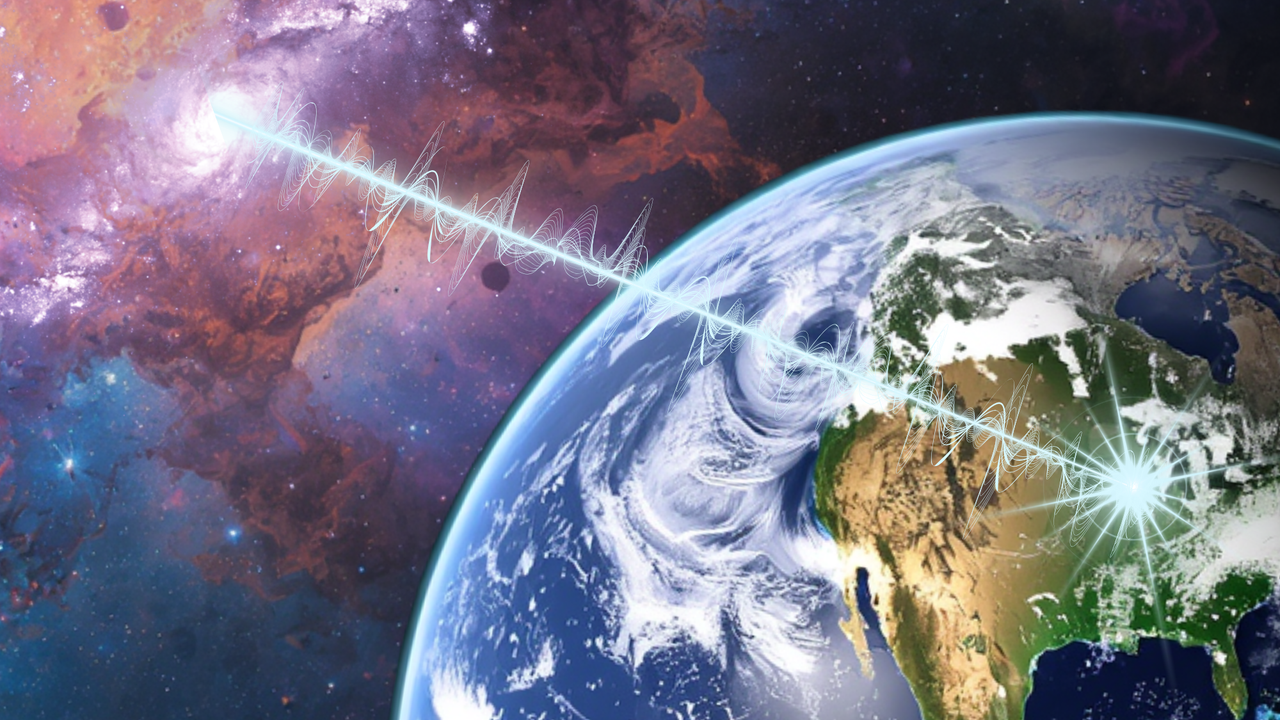
Fast radio bursts, or FRBs, are brief, intense pulses of radio energy that arrive at Earth from across the cosmos. Each burst lasts only milliseconds, yet carries enough energy to detect from billions of light-years away. These transient signals have confounded astronomers since their discovery in 2007, but recent research reveals they may unlock answers to the universe's deepest structural questions.
FRBs originate from sources we do not yet fully understand. Some bursts repeat; others fire only once. The signals travel through the intergalactic medium, passing through clouds of gas, dust, and the invisible scaffolding of dark matter that binds galaxies together. As each pulse travels to Earth, it disperses across different radio frequencies at different rates, a phenomenon called dispersion. This dispersion signature acts as a cosmic fingerprint, encoding information about the material the burst passed through.
Astronomers exploit this property to measure the distribution of matter between us and distant FRB sources. The integrated electron column density, or DM value, quantifies how much ionized gas the signal encountered. When combined with the redshift of a source, which reveals how far away it lies, FRBs become tools for mapping the "missing baryons" problem. Theoretical models predict the universe should contain far more normal matter than observations reveal. Fast radio bursts help locate this hidden material, distributed throughout intergalactic space.
This application extends to dark matter itself. The large-scale structure of the universe traces the gravitational influence of dark matter, which comprises roughly 85 percent of all matter. FRBs passing through regions of high dark matter density experience additional dispersion effects beyond what visible matter alone would produce. By analyzing hundreds or thousands of FRBs with known distances, researchers can construct three-dimensional maps of dark matter distribution across cosmic history.
Dark energy presents an even more profound puzzle. This mysterious force, discovered through observations of accelerating cosmic expansion in 1998, comprises roughly 68 percent of the universe's total energy density. Its nature remains unknown. FRBs offer an independent method to measure the cosmic expansion rate, the Hubble constant, by comparing the dispersion of signals to their redshifts. Multiple measurements using different methods help constrain whether dark energy truly remains constant or evolves over time.
The field is in early stages. Major surveys like the Canadian Hydrogen Intensity Mapping Experiment (CHIME) have detected hundreds of FRBs since 2018, vastly exceeding previous discovery rates. The Australian Square Kilometre Array Pathfinder (ASKAP) and the Very Large Array (VLA) add to the catalog. As detection numbers grow, statistical power increases. Each new FRB from a properly localized source adds another data point to the cosmic graph.
Understanding FRB origins remains a parallel challenge. Leading candidates include magnetars, neutron stars with extraordinarily powerful magnetic fields, and compact objects in binary systems. Some models invoke exotic physics. Resolution of this question may come through optical afterglow detections, gravitational wave observations, or neutrino associations that correlate FRBs with other cosmic messengers.
The next decade promises rapid advances. Radio telescopes under construction will detect thousands of FRBs annually. This explosion in data will transform these mysterious signals into systematic probes of dark matter, dark energy, and the universe's fundamental composition and evolution.