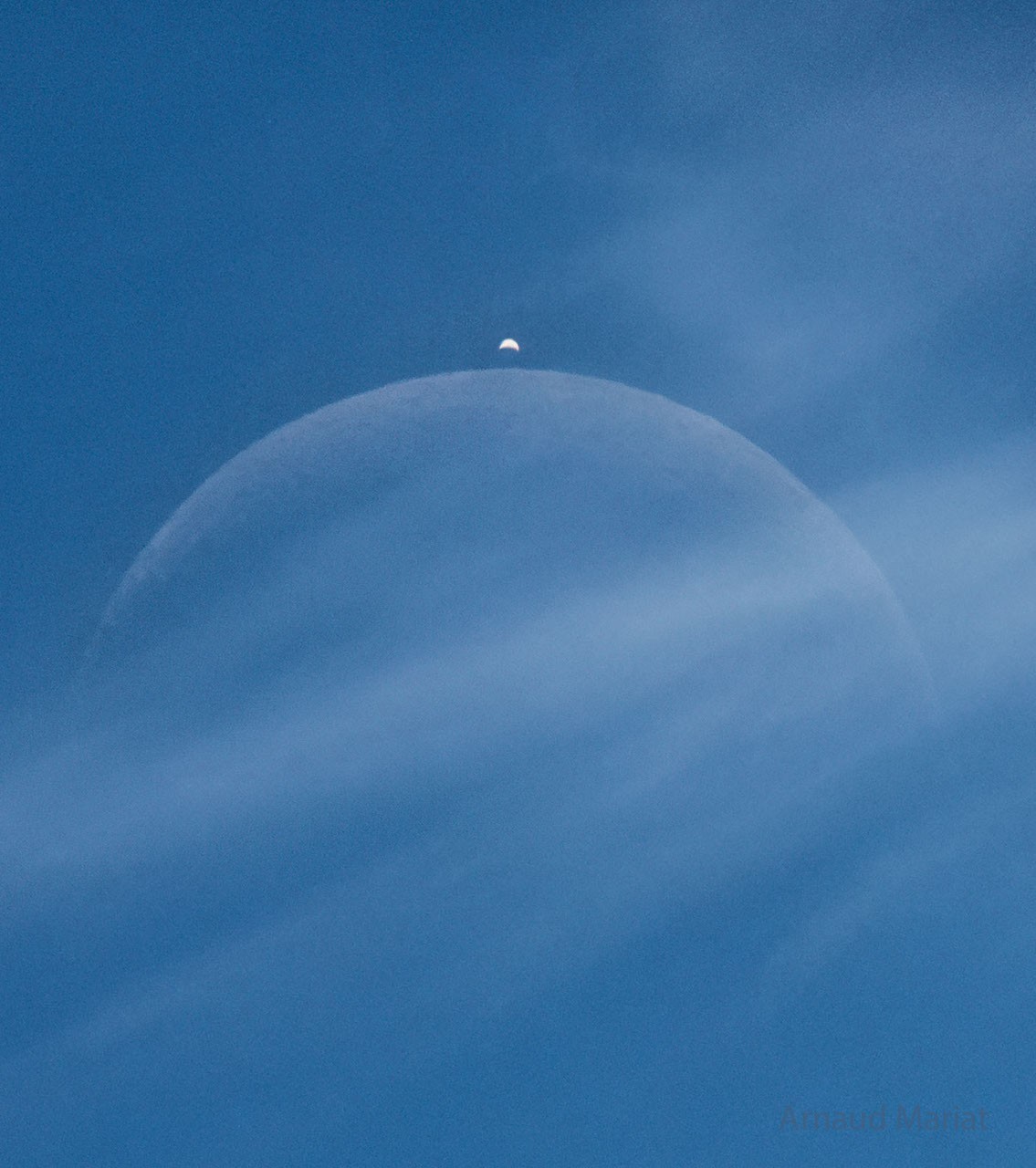
# Moon to Block Venus from Earth's View in Rare 2026 Daytime Occultation
On September 15, 2026, the Moon will pass directly in front of Venus, creating an occultation visible to observers across parts of Earth during broad daylight. This event ranks among the rarest celestial alignments, occurring because Venus appears bright enough to observe even when the Sun dominates the sky.
Occultations happen when one celestial body blocks another from our viewpoint. While lunar occultations of stars occur regularly, Venus occultations prove exceptionally uncommon. Venus shines as the second-brightest object in our sky after the Sun, reaching magnitude -4.7 at its brightest. Only the Moon's exceptional brightness permits observers to track Venus through the glare of day, and only when the geometric alignment places them in the same region of sky.
The 2026 event will unfold over several hours as the Moon's leading edge approaches Venus, begins to cover the planet's disk, reaches maximum occultation, and finally reveals Venus on the Moon's opposite edge. The exact timing and visibility depend on the observer's geographic location. Parts of southern Spain, North Africa, and the Middle East will experience the best viewing conditions. Other regions across Europe, Africa, and western Asia will witness partial occultations. North America will see nothing, as the geometry places the occultation entirely on the opposite side of Earth.
Observers equipped with binoculars or small telescopes should find the event spectacular. As the Moon's limb approaches Venus, Earthbound watchers will see Venus as a thin crescent, illuminated by sunlight reflected from the lunar surface. The moment the Moon's edge touches Venus marks the first contact. During occultation, Venus disappears behind the Moon's dark side, reappearing at the last contact as it emerges from behind the lunar disk.
Such occultations hold scientific value beyond visual spectacle. They provide precise positional measurements of both bodies. The exact timing of the occultation allows astronomers to refine lunar orbital parameters and Venus's position with extraordinary accuracy. Ground-based observations, combined with spacecraft data from missions like BepiColombo and the Akatsuki orbiter studying Venus, build a comprehensive picture of planetary and lunar positions across our solar system.
The rarity of daytime occultations stems from orbital mechanics. Venus takes 225 Earth days to orbit the Sun, while the Moon completes its lunar month in 29.5 days. The planes of their orbits don't coincide perfectly, so close alignments occur infrequently. The last daytime occultation of Venus by the Moon happened on November 13, 1981. The next after 2026 won't occur until August 12, 2107. This 126-year span between events underscores how unusual such alignments truly are.
Skywatchers planning observations should obtain proper equipment and solar filters if using telescopes pointed toward the daytime sky. The Astronomy Picture of the Day archive regularly features solar eclipse and occultation content offering preparation guidance. Organizations including NASA and amateur astronomy clubs will publish detailed visibility maps and timing predictions as September 2026 approaches.