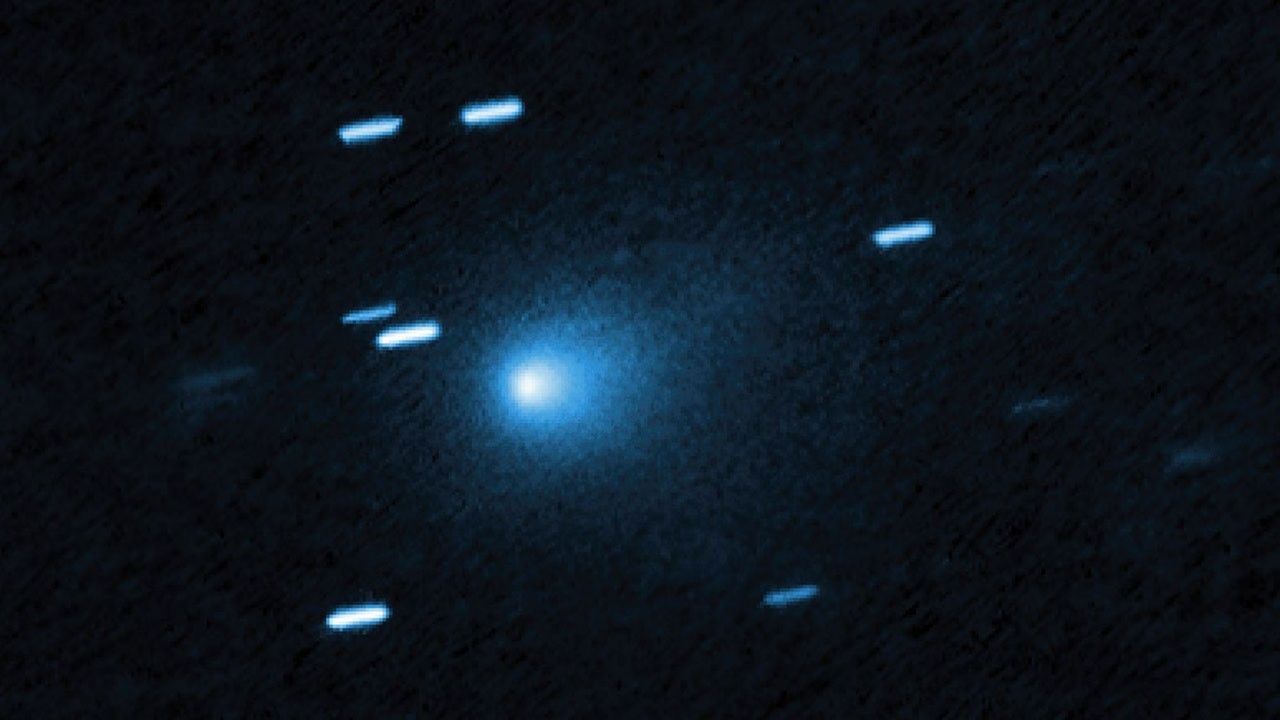
# Interstellar Comet 3I/ATLAS Formed in Its Star's Shadow, New Analysis Reveals
Astronomers studying the interstellar comet 3I/ATLAS have determined that this visitor from another star system likely originated in a region of its parent solar system where starlight never penetrated. The finding reshapes understanding of how planets and comets assemble around distant stars and what conditions allow objects to survive the violent journey through interstellar space.
3I/ATLAS entered our solar system in 2017 and became only the second confirmed interstellar interloper ever observed, following 1I/Oumuamua's famous passage in 2016. The comet's composition and trajectory offered astronomers rare direct evidence about planetary formation processes occurring light-years away.
Analysis of the comet's chemical fingerprint reveals a composition consistent with formation in the outer reaches of its home star system, specifically in regions where the parent star's radiation never reached. These shadowed regions exist in nearly all young planetary systems, where dust and debris block incoming light. Comets and planetesimals forming in these darkness-shrouded zones experience different chemical and thermal histories than objects created closer to their star.
The discovery matters because it confirms theoretical predictions about planetary system architecture across the galaxy. If 3I/ATLAS formed in such an outer, dark zone, it suggests that ejection mechanisms powerful enough to launch comets from distant systems operate throughout the universe. Gravitational interactions with forming giant planets likely booted 3I/ATLAS into an elliptical orbit that eventually carried it beyond its home system's gravitational influence and into interstellar space.
Observations from multiple facilities contributed to this analysis. Ground-based telescopes captured the comet's light signature while it brightened as it approached Earth. The data revealed volatile compounds frozen within its nucleus, indicating preservation in cold, protected conditions for billions of years. These chemical markers match predictions for objects formed far from their parent star's warmth.
The research extends beyond simple comet classification. Understanding where interstellar objects originate provides a window into planetary formation at other stars. Every comet reaching our neighborhood carries embedded records of its birth environment. The parent star's radiation output, the protoplanetary disk's structure, and gravitational dynamics that shaped the original system all influence what compounds the comet contains and how it behaves.
Future interstellar visitors will receive similar scrutiny. The Pan-STARRS survey that detected 3I/ATLAS continues monitoring the skies. The Vera C. Rubin Observatory, coming online in late 2024, will dramatically increase detection rates for distant, faint objects including additional interstellar comets. Each discovery accelerates the transition from studying single examples to building a statistical picture of planetary systems beyond our own.
The comet itself has long since receded past Neptune's orbit, departing our solar system as it arrived: a messenger from another world. Its passage left behind crucial evidence that planetary systems worldwide share fundamental formation mechanisms, and that the violent early epochs of star and planet assembly produce objects hardy enough to traverse the cold void between stars.