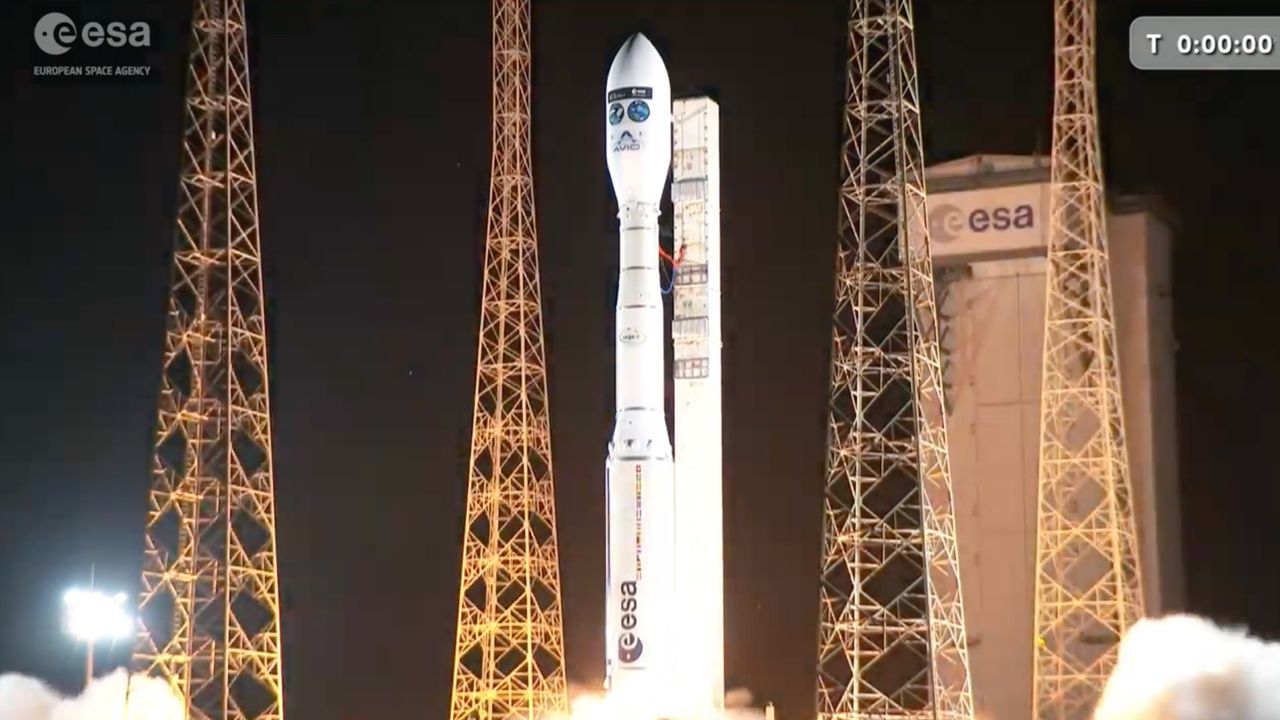
The European Space Agency's Vega C rocket lifted off from the Guiana Space Centre in French Guiana on September 14, carrying two Earth observation satellites into orbit. The mission deployed the FLEX and Copernicus-3C spacecraft, advancing Europe's capabilities in environmental monitoring and climate science.
FLEX, the Fluorescence Explorer, represents a novel approach to understanding plant health across the globe. The satellite detects fluorescence emitted by vegetation when plants photosynthesize, providing direct measurements of how efficiently crops and forests convert sunlight into growth. This data enables scientists to map plant stress from drought, disease, or heat before visible damage appears on the landscape. FLEX fills a gap in Earth observation by measuring photosynthetic activity itself rather than relying on proxy indicators like greenness indices. The mission operates as part of the ESA's Earth Explorer program, which funds innovative science missions addressing key environmental questions.
Copernicus-3C joins the Copernicus constellation, the European Union's cornerstone satellite program for environmental monitoring and emergency response. The Copernicus program provides free, open satellite data to governments, scientists, and organizations worldwide. Copernicus-3C specifically carries infrared sensors for monitoring thermal variations across Earth's surface, supporting applications ranging from wildfire detection to sea surface temperature mapping and urban heat island analysis. The previous Copernicus-3B satellite, launched in 2022, established the baseline for this thermal monitoring mission.
The Vega C rocket itself represents European launch sovereignty in South America. Built by Arianespace, the Vega C is a small-lift launch vehicle designed to carry payloads up to 2.3 metric tons to low Earth orbit. The rocket stands 34 meters tall and relies on solid rocket boosters, offering rapid launch capabilities for time-sensitive Earth observation missions. The Guiana Space Centre serves as the primary launch facility for ESA missions, operated jointly by the ESA and French space agency CNES.
This launch advances Europe's independence in accessing space. The Vega C enables European missions to reach orbit without reliance on external partners, a capability reinforced after Russia's invasion of Ukraine severed launch options aboard Russian Soyuz rockets from the same facility. The ESA suspended Soyuz launches from French Guiana in 2022, making reliable European launch infrastructure essential for the continent's space agenda.
FLEX and Copernicus-3C together strengthen Europe's Earth observation network. Scientists will combine FLEX measurements of plant photosynthesis with Copernicus thermal and optical data to build comprehensive assessments of ecosystem health, agricultural productivity, and climate responses. The missions support Europe's climate commitments and the European Green Deal, which targets climate neutrality by 2050. Real-time satellite data from these missions feeds into emergency response systems, helping authorities respond to natural disasters including floods, earthquakes, and volcanic eruptions.
The deployment of FLEX and Copernicus-3C underscores the ESA's commitment to observing Earth's changing systems. These missions address pressing questions about vegetation dynamics, thermal anomalies, and climate feedback mechanisms. By providing continuous, calibrated observations from orbit, they deliver the data foundation that climate models, agricultural systems, and disaster response networks depend upon. The European space program continues positioning satellite Earth observation as a public utility for understanding and responding to environmental change at continental and global scales.