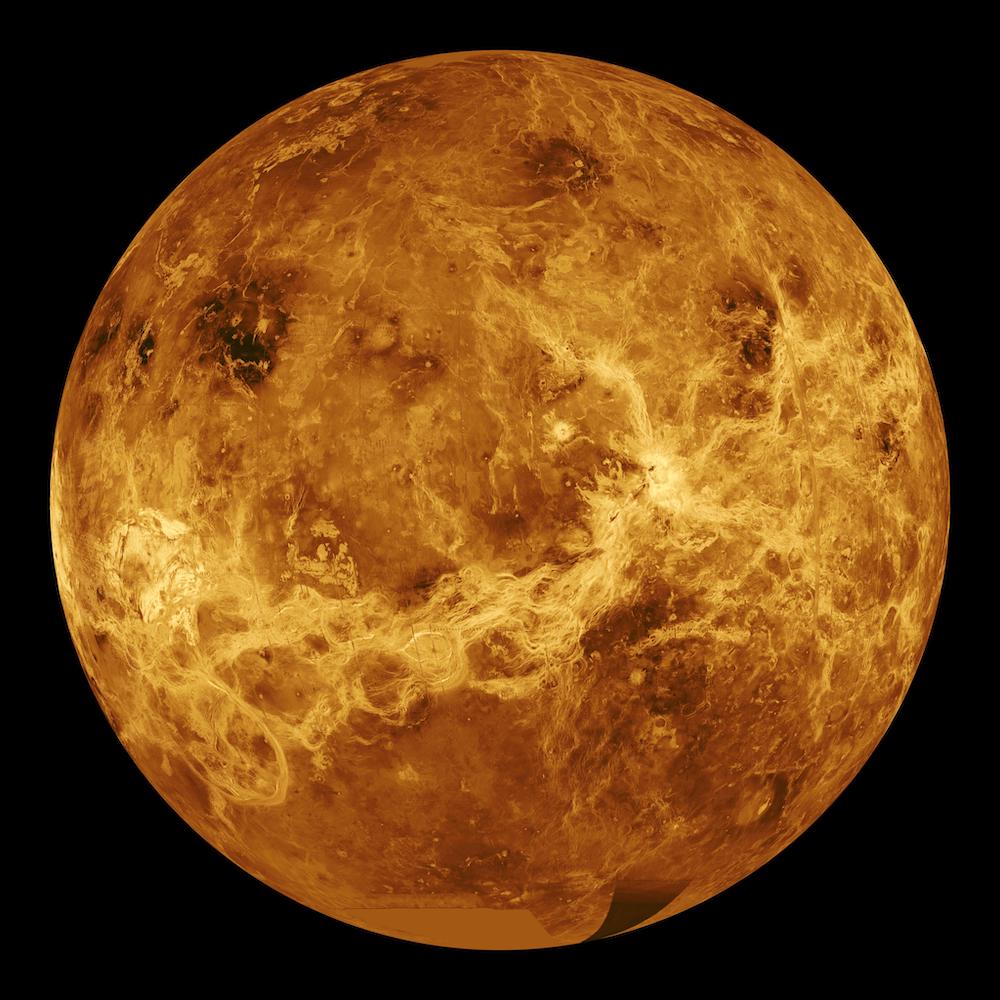
Venus may have harbored a moon billions of years ago, but orbital dynamics guaranteed its destruction. New research exploring why Earth's neighbor lacks the satellite that defines our own world reveals a brutal tidal fate.
Earth and Venus formed under similar conditions. Both rocky terrestrial planets orbit within the inner solar system. Both possess comparable sizes and masses. Yet Venus remains moonless while Earth's Moon dominates our night sky. Astronomers have long wondered whether Venus ever captured a lunar companion, and if so, what happened to it.
A recent study published in peer-reviewed research explores this question through gravitational modeling and orbital mechanics. The findings suggest that if Venus possessed a moon during its early history, tidal interactions between the planet and satellite would have sealed its doom. The mechanism mirrors what threatens Jupiter's moon Io and shapes Saturn's system today.
Here's how the process works. When a moon orbits close enough to a planetary body, tidal forces stretch and compress it. These forces generate heat through friction inside the satellite. Simultaneously, the planet's gravity gradually drags the moon inward through a process called orbital decay. For Venus, this inward spiral would have accelerated dramatically as the moon approached.
The research models different scenarios for a hypothetical Venusian moon. Regardless of the satellite's initial mass or orbital distance, the calculations converge on a single outcome. Any moon would eventually spiral into Venus and disintegrate in the planet's atmosphere. The timeframe for this destruction spans millions to tens of millions of years, relatively brief on geological scales.
This contrasts sharply with Earth's Moon, which resides at a stable distance of 384,400 kilometers. Our Moon drifts away from Earth at about 3.8 centimeters per year, a consequence of tidal braking that gradually transfers orbital energy outward. This process works in reverse for closer orbits around Venus.
Venus presents an even harsher environment than Earth for maintaining a satellite. The planet's extreme surface temperature, crushing atmospheric pressure, and dense cloud cover hint at a violent history. Solar radiation batters the upper atmosphere. The greenhouse effect from a runaway CO2 cycle altered the planet's climate fundamentally. These factors may have created conditions hostile to lunar stability.
The research carries implications for understanding planetary formation in other star systems. Astronomers studying exoplanets increasingly recognize that moon-planet interactions shape planetary evolution. Tidal heating can drive geological activity. Orbital decay can erase moons entirely. Systems around other stars may exhibit the same destructive dynamics that would have claimed any ancient Venusian moon.
The absence of a moon at Venus remains puzzled by scientists studying planetary formation. This new work suggests the answer may be simpler than once thought. Venus may have hosted moons during the chaotic early solar system, when countless bodies collided and merged. But the physics of orbital mechanics guaranteed their demise. Any moon Venus captured fell victim to gravitational forces that relentlessly pulled it downward into oblivion.