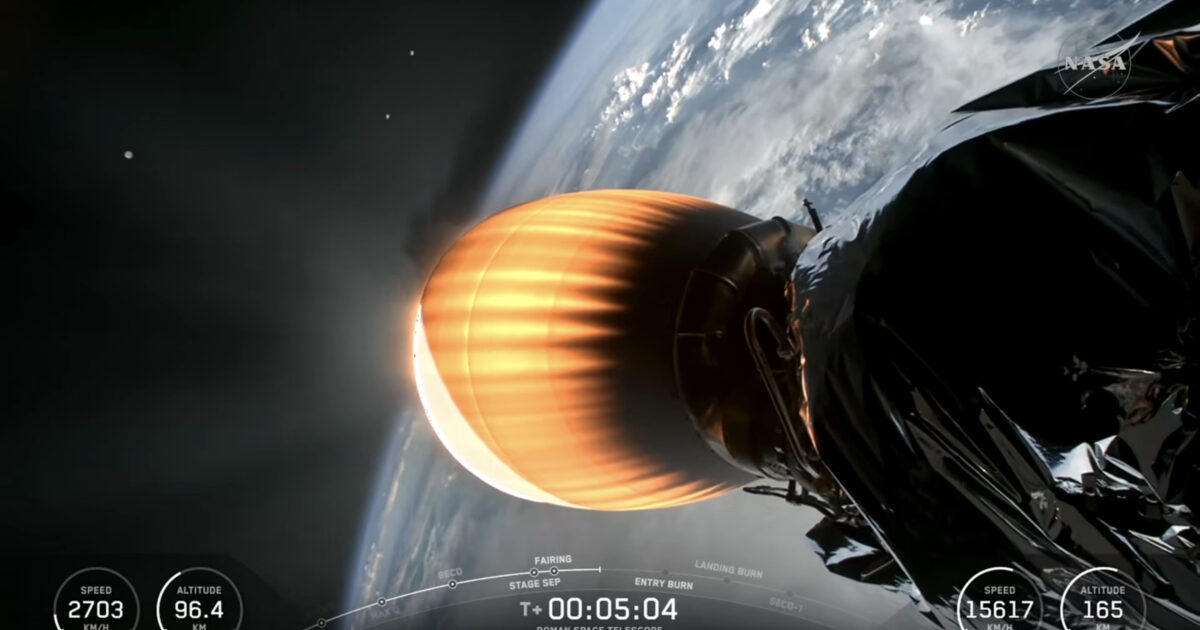
# NASA's Nancy Grace Roman Space Telescope Launches Into Orbit
NASA launched the Nancy Grace Roman Space Telescope into orbit, deploying a new instrument designed to revolutionize the study of exoplanets and dark energy across the cosmos. The observatory represents the agency's most ambitious astrophysics mission since the James Webb Space Telescope reached its destination at Lagrange Point 2 in early 2022.
The Roman telescope carries a primary mirror measuring 2.4 meters in diameter, matching the Hubble Space Telescope's light-gathering capability. But Roman's advanced instruments will operate across infrared wavelengths with unprecedented sensitivity, enabling astronomers to detect distant galaxies, measure the expansion rate of the universe, and identify habitable exoplanets orbiting distant stars.
The mission draws its name from Nancy Grace Roman, NASA's first chief of astronomy and a pioneering figure in space science who championed the Hubble program during its development. Her legacy of expanding humanity's view of the cosmos through orbital observatories now manifests in this sophisticated instrument.
Roman's primary science objectives address three fundamental questions in modern astronomy. First, the telescope will perform a census of exoplanets by detecting the light from worlds orbiting other stars through direct imaging and gravitational microlensing techniques. This capability will identify potential candidates for future missions seeking biosignatures on potentially habitable worlds. Second, Roman will measure the properties of dark energy, the mysterious force driving the universe's accelerating expansion, by mapping billions of galaxies and observing distant supernovae. Third, the observatory will detect and characterize stellar structures in nearby galaxies, providing unprecedented views of star formation and black hole behavior across cosmic distances.
The Wide Field Instrument aboard Roman delivers a field of view 100 times larger than Webb's, allowing the telescope to survey vast regions of sky in single observations. This broad perspective, combined with infrared sensitivity, makes Roman ideally suited for population-level studies of exoplanets and galaxies that require statistical samples rather than individual deep-field observations.
Roman will occupy a station near the Sun-Earth Lagrange Point 2, approximately one million miles from Earth, the same location as the James Webb Space Telescope. This position minimizes thermal interference and allows Roman to observe with minimal interference from Earth and solar radiation. The observatory requires several months to reach its destination, unfold its intricate structures, calibrate its instruments, and commence routine science operations.
The mission represents a collaboration between NASA's Goddard Space Flight Center, contractors including Ball Aerospace and other partners. The project succeeded earlier developmental challenges and cost overruns, ultimately delivering an observatory positioned to transform multiple fields of astronomy. Launch atop a commercial heavy-lift vehicle marks a transition in how NASA deploys its largest scientific instruments, reflecting the maturation of commercial spaceflight services.
Roman joins Webb and other orbital observatories in creating a coordinated infrastructure for modern astronomy. Where Webb excels at observing the earliest galaxies and detailed structures in nearby space, Roman surveys broader regions and detects countless exoplanets, enabling targeted follow-up observations by other facilities. This complementary approach multiplies the scientific return from America's investment in space-based astronomy across the next decade.