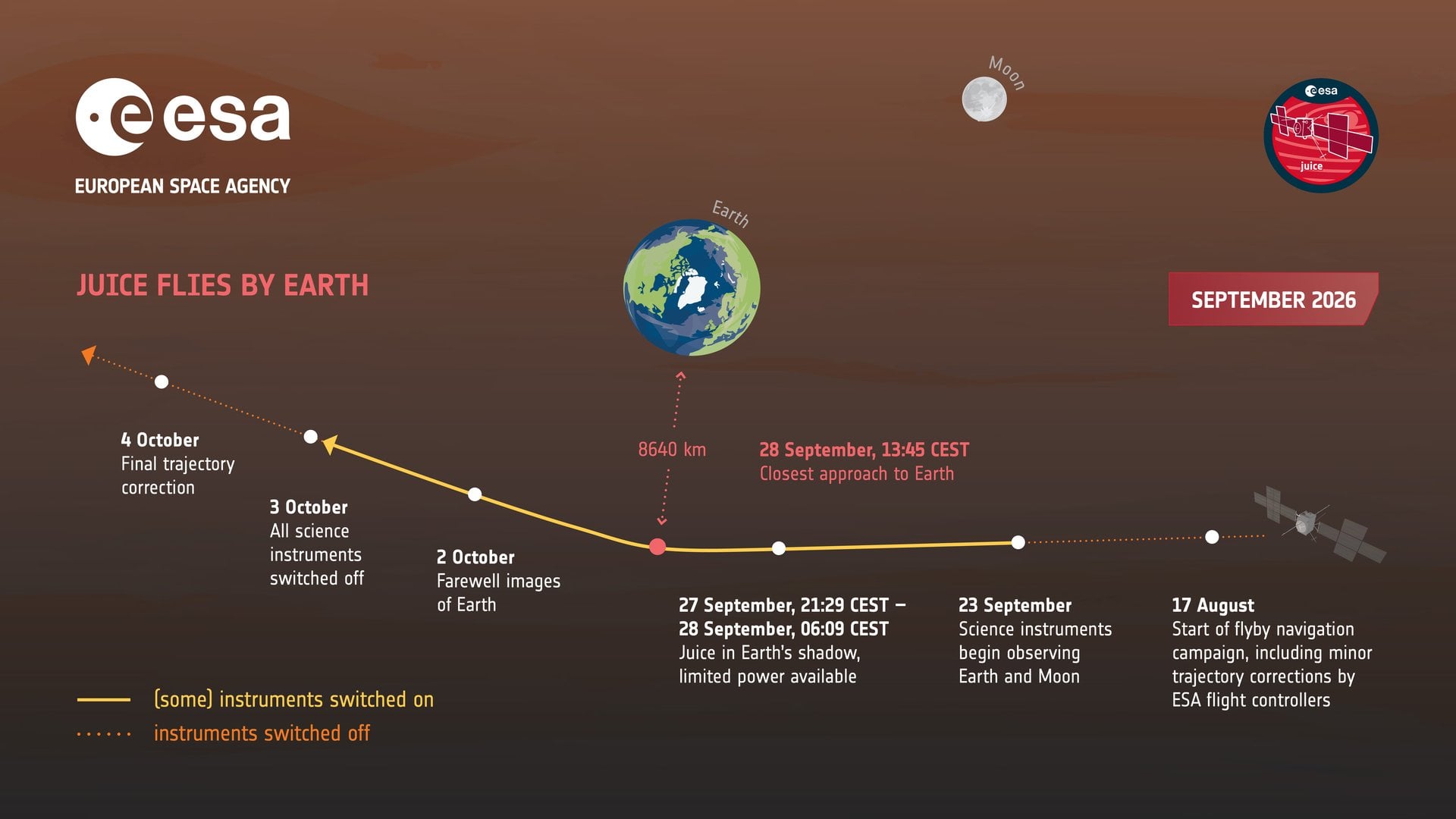
The European Space Agency's Jupiter Icy Moons Explorer (JUICE) spacecraft will perform a critical gravity assist maneuver at Earth on September 28, using our planet's gravitational field to redirect its trajectory toward Jupiter. This flyby represents a pivotal moment in the mission's multi-year journey to study the gas giant's icy moons, particularly Europa, Ganymede, and Callisto.
JUICE launched in April 2023 from French Guiana aboard an Ariane 5 rocket. The spacecraft carries advanced instrumentation designed to investigate whether subsurface oceans beneath the thick ice shells of these moons could harbor conditions suitable for life. The mission targets Ganymede specifically, where JUICE will eventually enter orbit to conduct detailed reconnaissance of this massive moon, which is larger than the planet Mercury.
Gravity assist maneuvers like this September 28 flyby allow spacecraft to gain or lose velocity without expending fuel. As JUICE passes through Earth's gravitational well, the planet's pull will alter the spacecraft's speed and trajectory, bending its path toward its final destination. ESA flight controllers have plotted this approach with precision to achieve the exact velocity adjustment needed for the spacecraft's continued acceleration toward Jupiter.
The timing of this maneuver reflects JUICE's extended travel profile. Rather than launching directly to Jupiter, which would require enormous fuel expenditure, mission planners designed a spiral trajectory using gravitational assists from Earth and Venus to gradually increase the spacecraft's speed relative to the Sun. This approach conserves fuel while allowing the spacecraft to reach Jupiter with sufficient velocity for orbital insertion.
JUICE carries ten scientific instruments shared among ESA, NASA, and international partners. These include visible and near-infrared spectrometers to analyze surface composition, a magnetometer to study the moon's magnetic environment, a laser altimeter for topographic mapping, and a radar instrument capable of penetrating ice shells to detect subsurface water. The mission directly supports humanity's search for biosignatures beyond Earth.
Europa remains particularly compelling because evidence suggests a global ocean exists beneath its cracked ice surface, maintained by tidal heating from Jupiter's gravitational pull. Ganymede, the mission's primary target, likely contains more water than all of Earth's oceans combined. Callisto represents another intriguing destination, with its own potential subsurface ocean. JUICE will systematically characterize each moon's geology, composition, and habitability potential.
After the Earth gravity assist on September 28, JUICE continues its journey with another planned assist at Venus in August 2024. The spacecraft arrives at Jupiter in July 2031, then conducts a tour of the Galilean moons before entering Ganymede orbit in December 2034. The mission duration extends through 2035, providing years of detailed scientific observations.
This September flyby, though brief, represents months of planning and navigation refinement. ESA's flight control team monitors the spacecraft's trajectory constantly, making minute adjustments to ensure the assist achieves its intended effect. For the mission's science team and the broader planetary science community, this maneuver signals another step forward in reaching one of the solar system's most intriguing destinations.