# Growing Plants Beyond Earth: New Research Tackles Deep-Space Agriculture
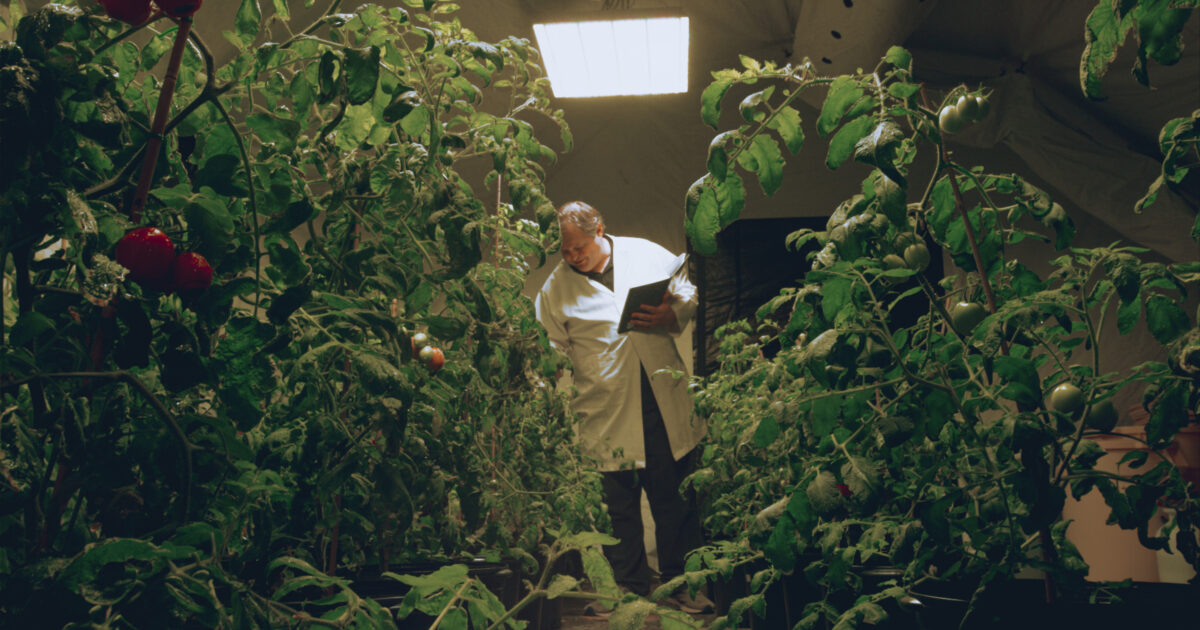
The Planetary Society awarded $50,000 through its 2023 Science and Technology Empowered by the Public (STEP) Grants program to a research team led by Dr. Andrew Palmer at Florida Institute of Technology. The funding supports investigation into deep-space agriculture, a practical necessity for sustaining human crews on extended missions beyond Earth orbit.
Long-duration spaceflight presents a brutal problem: astronauts cannot survive on stored food alone. A crew traveling to Mars, or stationed on the Moon for months, requires fresh food production. Current supply chains cannot support missions lasting years. Growing food in space solves this constraint, but the environment presents extreme challenges. Microgravity disrupts plant physiology. Radiation exposure damages genetic material. Limited water, nutrients, and growing space demand efficiency unknown in terrestrial agriculture. Equipment mass costs roughly $10,000 per kilogram to launch, making every system count.
Palmer's team addresses these barriers through systematic research. The work builds on decades of orbital agriculture experiments, including the Advanced Plant Habitat on the International Space Station and earlier experiments conducted by NASA and international space agencies. Yet significant gaps remain in our knowledge of how plants perform during deep-space missions beyond Earth's protective magnetic field.
Deep-space agriculture differs from ISS experiments in one critical way: radiation exposure. The International Space Station orbits within Earth's magnetosphere, which shields occupants from most solar and galactic radiation. A spacecraft en route to Mars or stationed on the lunar surface faces direct cosmic radiation and solar particle events. These conditions alter plant growth rates, nutrient uptake, and genetic stability. Understanding these effects requires targeted investigation.
The STEP Grants program itself reflects changing dynamics in space research. The Planetary Society, a nonprofit advocacy organization founded in 1980, established STEP to fund early-stage research that might not fit traditional government funding mechanisms. The program emphasizes public engagement and accessible science. By supporting Palmer's work, the society positions deep-space agriculture as a public priority alongside more visible missions.
The $50,000 award represents seed funding. It enables Palmer's team to conduct preliminary experiments, gather data, and build a foundation for larger grants from NASA or other federal agencies. This funding structure accelerates innovation. Universities and research institutes can test hypotheses quickly without waiting for multi-year federal grant cycles.
The practical outcomes matter enormously for human spaceflight. NASA's Artemis program aims to return humans to the Moon and establish sustained presence. The agency's Mars exploration roadmap targets crewed missions in the 2030s and 2040s. Both programs depend on solving the food production problem. Crops grown in controlled environments in space reduce resupply missions, lower launch costs, and improve crew morale through access to fresh food.
Palmer's research also connects to broader questions about human adaptation to space environments. Growing plants in microgravity and radiation reveals how living systems respond to extreme conditions. This knowledge applies beyond agriculture: understanding plant physiology in space informs human physiology research and helps design better life support systems.
The work underway at Florida Institute of Technology represents incremental progress on a generational challenge. Each experiment answers specific questions and raises new ones. The accumulation of these answers builds the technical foundation for human settlements beyond Earth. That foundation does not rest on rockets or habitats alone. It rests on the ability to grow food where humans cannot.