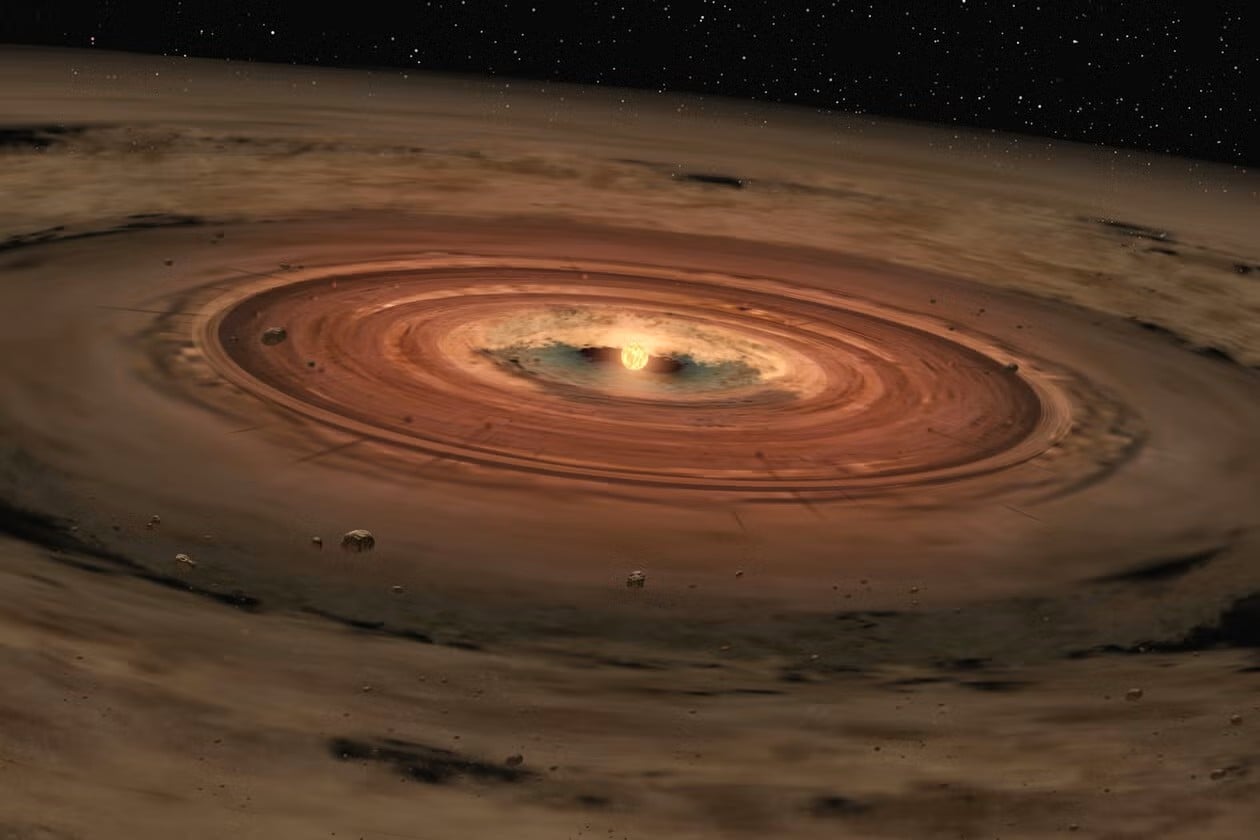
The earliest planets in our solar system formed in a scorching, metal-rich environment fundamentally different from the icy, outer-system conditions that shaped later planetary migration. Damanveer Grewal and his team at Yale University published research in Nature Astrophysics arguing that the inner solar system operated under what researchers call a "hot" formation scenario, not the long-favored "cold" disk model that has dominated planetary science for decades.
This distinction matters because it reshapes understanding of how rocky planets like Earth assembled during the first few million years after the Sun ignited. The "hot" versus "cold" debate concerns the chemical composition and temperature gradients within the protoplanetary disk, the swirling cloud of gas and dust from which all planets coalesced. A hot disk meant that volatile compounds like water, carbon dioxide, and nitrogen existed primarily as gases rather than ice. A cold disk preserved these materials in frozen form, allowing them to concentrate further from the star.
Grewal's research draws on geochemical signatures preserved in Earth's composition today. By analyzing meteorites and the elemental ratios locked within our planet's interior, the Yale team reconstructed the conditions under which Earth and other terrestrial planets must have formed. Their data indicates that the inner solar system experienced temperatures and chemical conditions consistent with a hot, volatile-poor environment during planetary assembly.
The implications reshape our grasp of planetary formation across the cosmos. If the solar system began in a fiery rather than frigid state, the mechanisms that delivered water, organic compounds, and other life-supporting materials to Earth would differ substantially from existing models. The research suggests that these essential ingredients arrived later, potentially delivered by impacts from outer-system bodies only after the terrestrial planets had largely completed their formation.
This hot-disk scenario also aligns with recent exoplanet discoveries. Astronomers have identified numerous planetary systems where giant planets orbit extremely close to their host stars, a configuration that demands explanation. The hot-disk model provides one mechanism for understanding how such systems assemble. Rocky planets may form close to stars under hot conditions, while giant planets migrate inward from cooler outer regions.
The Yale findings build on decades of meteorite analysis and computational planetary-formation models. Earlier theories, particularly the Grand Tack hypothesis proposed by planetary scientists like Konstantin Batygin, envisioned a young solar system where Jupiter migrated inward then back outward, shepherding material and fundamentally reorganizing planetary architecture. The new research complements rather than contradicts this framework by specifying the thermal conditions under which such processes operated.
Further refinement awaits. Upcoming analysis of lunar samples returned by NASA's Artemis missions and continued examination of martian geology through rovers like Perseverance will provide additional constraints on early solar system conditions. These investigations will either reinforce or challenge Grewal's hot-disk conclusions. The question of fire versus ice, once purely theoretical, now carries testable predictions that future missions can verify.