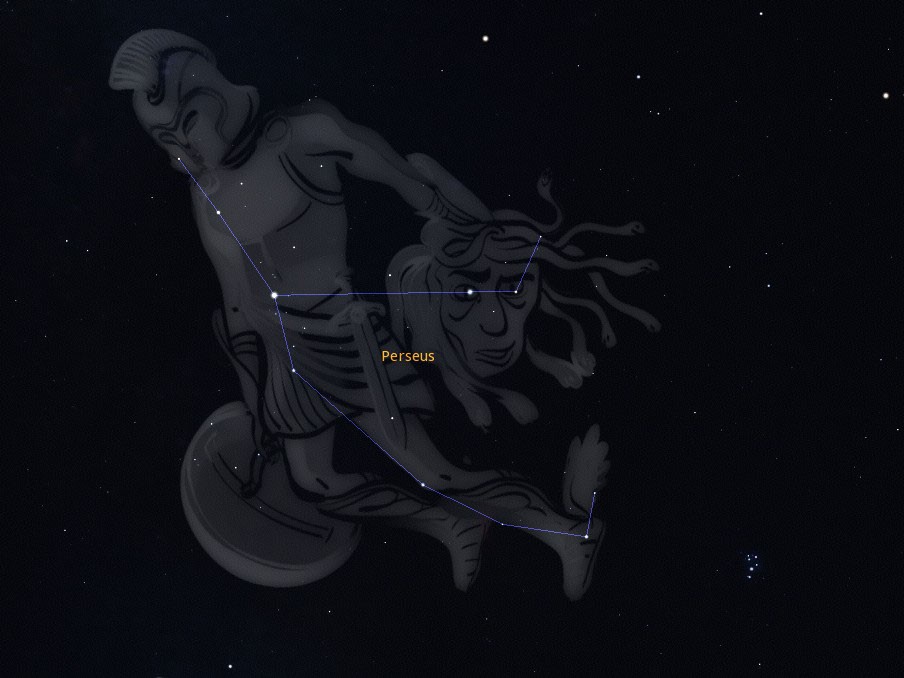
Algol, the famous eclipsing binary star in Perseus, offers naked-eye observers a dramatic celestial performance each autumn. Known colloquially as the Demon Star or the Ghoul, Algol earned its sinister reputation from ancient astronomers who noticed its brightness fluctuate with eerie regularity. This variability stems not from the star's intrinsic instability but from a companion star that periodically passes in front of it, blocking its light from Earth.
The star system consists of a hot, luminous primary star orbited by a dimmer companion on a 2.87-day cycle. Every 2.87 days, the companion crosses directly between Algol and Earth, dimming the system by roughly one magnitude. The eclipse lasts about 10 hours, making Algol easy to track without instruments over successive nights. Ancient astronomers, lacking modern spectroscopy, could only observe this disappearing act and interpret it through mythological lenses. They named it for Medusa's baleful gaze.
October provides ideal viewing conditions. Algol appears in the northeastern sky after 9 PM as autumn deepens. The constellation Perseus rises higher each night, becoming increasingly visible from mid-northern latitudes. Cassiopeia, the distinctive W-shaped queen, and Andromeda, home to our nearest galactic neighbor, occupy the same region of sky. This October viewing window positions all three within reach of a single skyward glance.
Algol holds profound significance for astronomy history. Its variability made it one of the first eclipsing binaries recognized by human observers. Modern photometry revealed the precise mechanics underlying the mythical narrative. The star system now serves as a laboratory for stellar physics, allowing astronomers to measure masses and radii of distant stars through careful observation of eclipse timing and light curves. Ground-based observers and space telescopes like TESS continue monitoring Algol and similar systems to refine our understanding of stellar evolution.
The name itself reflects how older cultures encoded astronomical observations into myth. In Greek tradition, Algol represented the eye of Medusa, the gorgon whose gaze turned mortals to stone. The blinking quality of Algol's apparent brightness fit this narrative perfectly. When astronomers later quantified the star's behavior, they discovered a physical explanation for the ancient legend. Binary systems like Algol populate the galaxy by the millions. Earth's brightest stars include many eclipsing binaries. Understanding these systems illuminates stellar masses, distances, and evolutionary pathways.
Observers need only binoculars or naked eyes to track Algol's dance. The star shines near magnitude 2.1 at maximum brightness and drops to magnitude 3.4 during eclipse. Comparison stars nearby allow casual astronomers to estimate brightness variations. Apps and online ephemerides now provide precise eclipse times, removing guesswork from observation.
October stargazing rewards both casual observers and serious amateur astronomers. Algol exemplifies how the night sky continues yielding scientific data to patient watchers. The Ghoul still blinks, its ancient name capturing something true about how celestial mechanics can seem ghostly when viewed through human perception.