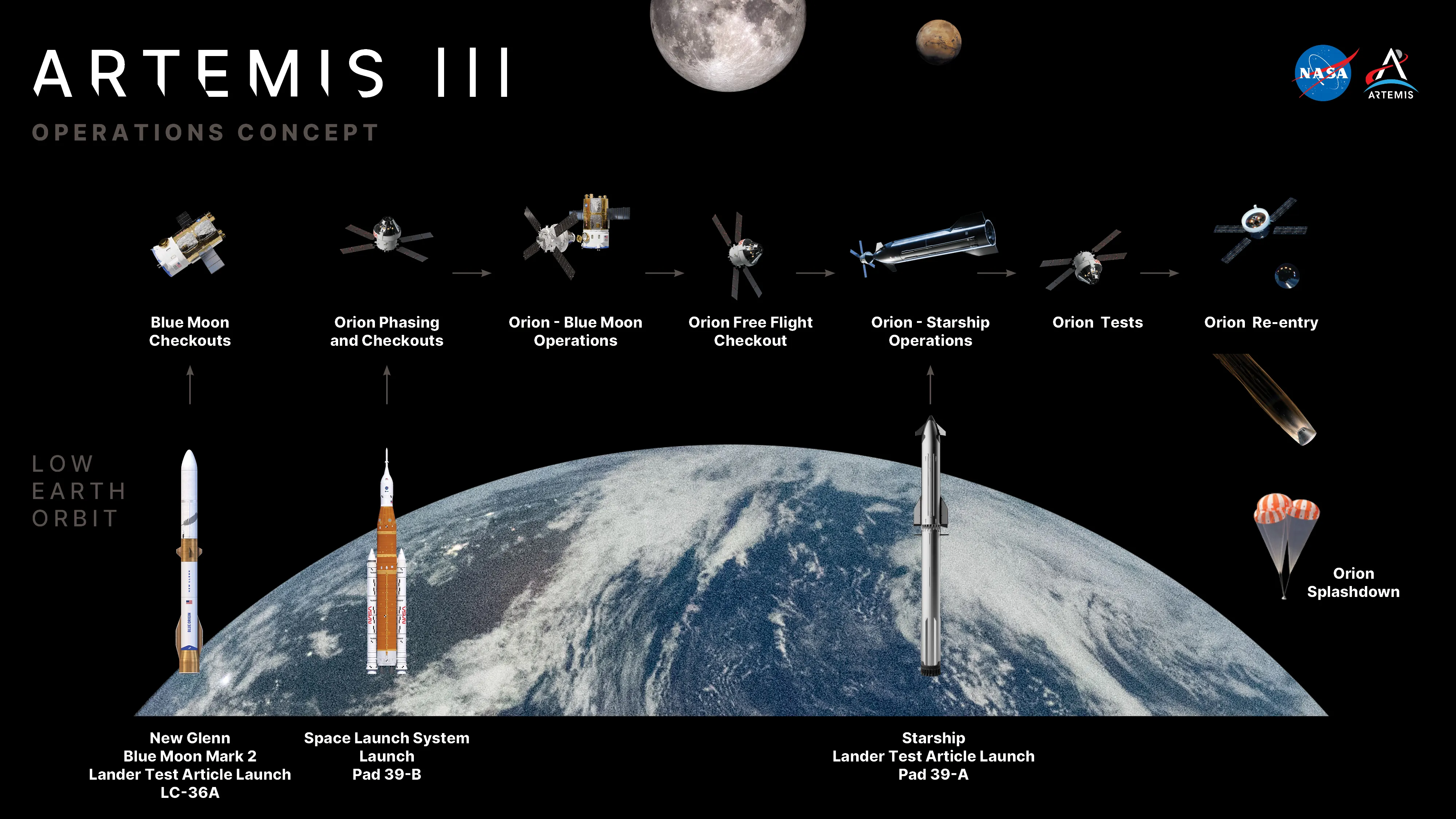
NASA plans to launch Artemis III in 2027 with a crew of four astronauts aboard the Orion spacecraft to test critical lunar landing systems before humans touch down on the Moon again. The mission represents one of the most technically demanding endeavors in NASA's history, serving as the essential proof-of-concept for the entire Artemis program's long-term lunar exploration architecture.
The crew includes NASA astronauts Randy Bresnik, Frank Rubio, and Andre Douglas, joined by European Space Agency astronaut Luca Parmitano. Rather than landing directly on the lunar surface, Artemis III will conduct its primary operations in low Earth orbit, where the team will validate the Starship Human Landing System (HLS) and other hardware that will eventually carry astronauts to the Moon's South Polar region.
This test mission answers a critical gap in NASA's current readiness. The Artemis I uncrewed test of Orion in 2022 validated the spacecraft's performance in deep space operations, and Artemis II will send a crewed Orion around the Moon in 2025. Artemis III fills the next logical step: demonstrating that NASA can safely rendezvous, dock, and operate the integrated Orion-to-lander transfer sequence in an environment where mission planners can respond to unexpected problems without the time delays and irreversible decisions imposed by lunar distance.
The Starship HLS, developed by SpaceX under NASA's Human Landing System program, represents a radical departure from Apollo-era landers. Standing roughly 50 meters tall, the vehicle must execute a propulsive descent to the lunar surface while carrying a crew cabin, life support systems, and enough fuel reserves to power an abort and return to orbit. Testing the vehicle's autonomous docking systems, fuel transfer procedures, and crew operations in Earth orbit before committing to a lunar landing reduces risk substantially.
Parmitano's inclusion underscores NASA's commitment to the Artemis Accords, a framework for lunar exploration that prioritizes international partnership. The ESA astronaut brings operational experience from multiple International Space Station expeditions and represents the agency's investment in shared human spaceflight objectives.
The timeline remains compressed but achievable. Artemis II's lunar flyby in 2025 will test Orion's heat shield, life support, and navigation systems on the high-energy return trajectory. Artemis III two years later will then validate the lander transfer and docking systems. A successful mission opens the pathway to Artemis IV in the early 2030s, which would send the first crew since Apollo 17 to land in the Moon's unexplored South Polar region, where permanently shadowed craters hold water ice reserves essential for sustained human habitation.
The South Polar landing zone represents the strategic objective for Artemis. Unlike Apollo missions concentrated near the equator, NASA targets regions where water-ice mining could support fuel production, oxygen generation, and consumable water for long-duration surface operations. Artemis III's orbital testing validates every system the landing crew will depend on, making this 2027 mission the bridge between proving Orion's capabilities and establishing humans as a permanent spacefaring species beyond Earth orbit.