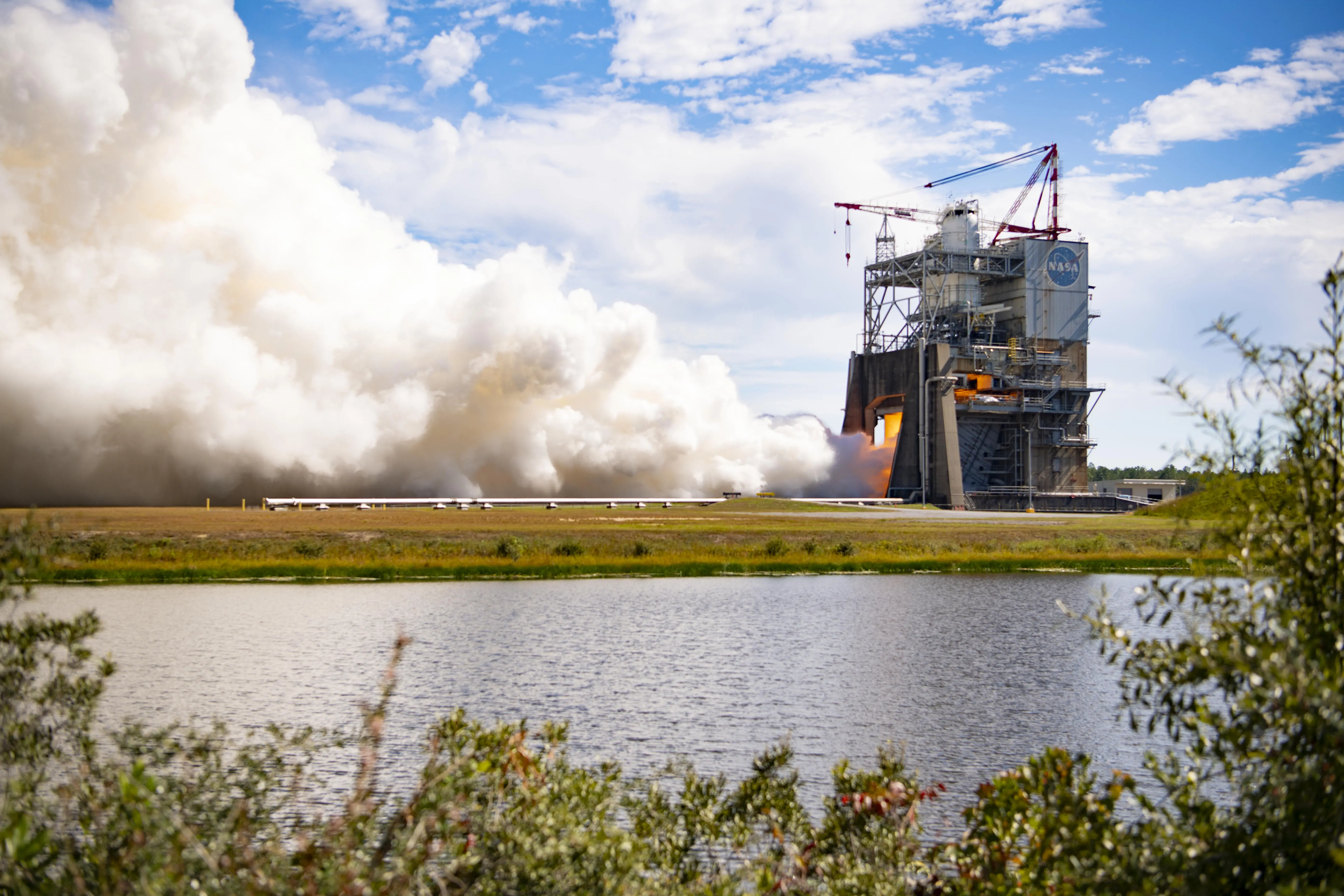
NASA's Stennis Space Center has successfully tested RS-25 engine No. 10001, advancing the propulsion systems that will carry astronauts to the Moon under the Artemis program.
The test occurred on October 21, 2026, at the Mississippi facility, where the RS-25 engine burned for 500 seconds at 111% power level. This duration matches the firing time required during actual Space Launch System rocket launches. The test validates the engine's performance envelope for operational missions.
The RS-25 represents the most powerful single-nozzle liquid-fueled rocket engine in operation. Each Space Launch System core stage requires four RS-25 engines clustered together to generate the 8.8 million pounds of thrust needed at liftoff. NASA developed the RS-25 technology decades ago for the Space Shuttle program, where it flew 135 times. The Agency now refurbishes and certifies both heritage shuttle engines and builds new RS-25s at Aerojet Rocketdyne's facilities to support multiple SLS missions.
Stennis Space Center serves as NASA's primary test site for rocket engines and stages. The facility operates B-2 test stands specifically designed for RS-25 testing, featuring massive water-cooled structures that absorb the extreme heat and acoustic energy generated by the engines. These stands can measure engine thrust, pressure, temperature, and vibration with extraordinary precision. Testing at Stennis eliminates risk to hardware and validates engine performance before flight commitment.
The hot fire test protocol subjects the RS-25 to conditions matching actual launch ascent. Engineers monitor hundreds of parameters throughout the burn, examining combustion stability, turbopump performance, injector flow patterns, and thermal conditions. Each test produces terabytes of data that engineers analyze to ensure the engine meets NASA's reliability requirements.
This test follows earlier RS-25 validation campaigns as NASA accelerates the Artemis program cadence. The Space Launch System currently has two certified flights: Artemis I in November 2022, an uncrewed test that flew the Orion spacecraft to lunar orbit, and Artemis II, scheduled for 2026, which will carry a four-person crew around the Moon. Subsequent SLS missions aim for lunar surface landings as part of NASA's broader lunar exploration architecture.
The RS-25 engine testing program directly supports Artemis III and beyond. Each additional SLS flight requires engines that have completed comprehensive ground testing and documentation. NASA's goal involves launching the SLS every 6-12 months during peak Artemis operations, which necessitates a robust production and testing pipeline.
The October 2026 test demonstrated that RS-25 engines continue performing reliably despite decades since the Space Shuttle program ended. The refurbishment and certification process ensures heritage engines retain full capability, while newly manufactured engines achieve the same performance standards. This dual-sourcing approach provides NASA with sufficient RS-25 inventory to execute an aggressive lunar exploration schedule.
Future RS-25 testing will include additional hot fire tests, stage-level testing with all four engines firing together, and final qualification before each flight. Stennis testing remains essential to astronaut safety and mission success for the Artemis program.