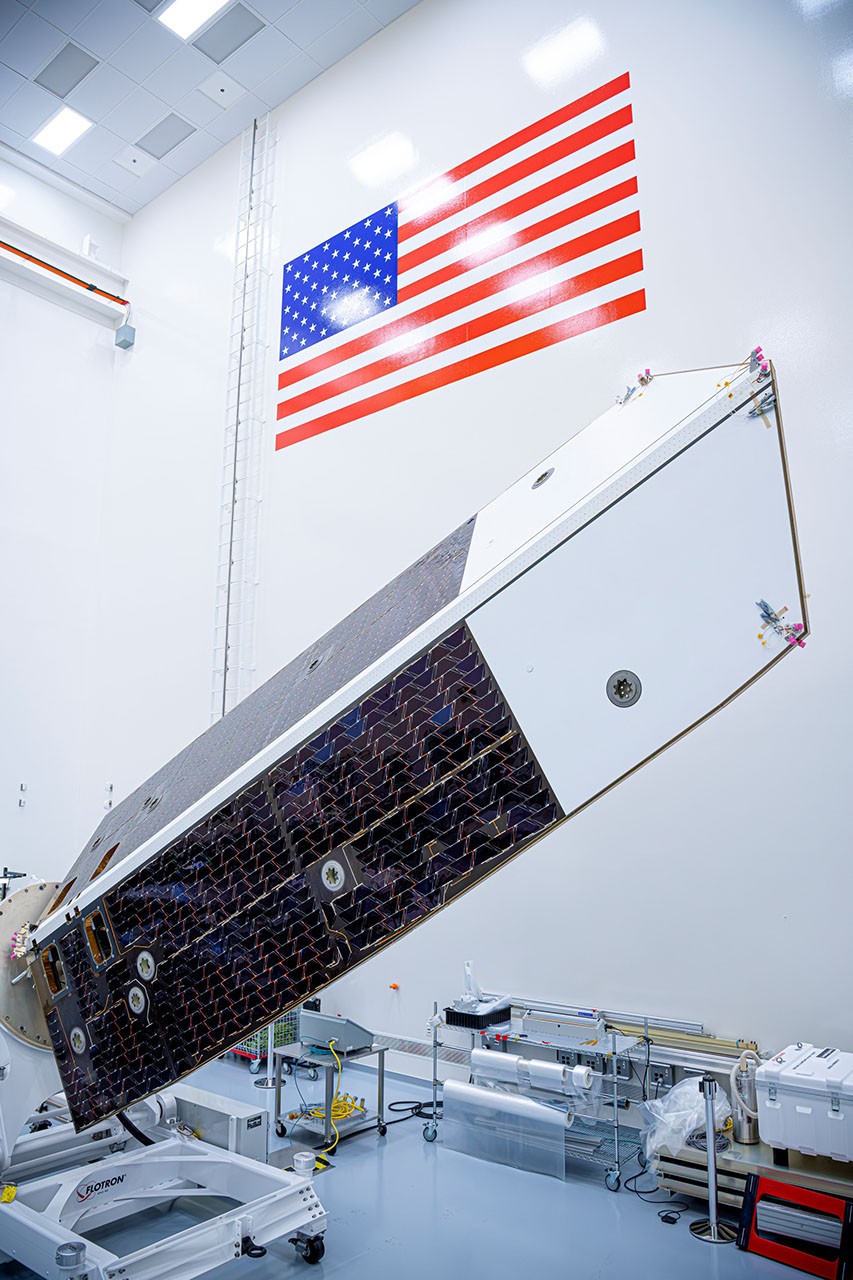
NASA's NEO Surveyor spacecraft continues assembly progress with a critical inspection of its large sunshade component at BAE Systems Space & Mission Systems facility in Boulder, Colorado. The sunshade underwent detailed examination in July 2026 as the mission approaches its planned launch window in 2028.
The sunshade represents one of the most architecturally demanding elements of the NEO Surveyor design. Standing 20 feet tall and measuring 8 feet wide at its base, the structure protects the spacecraft's infrared instruments from solar radiation and thermal interference. Two flat surfaces compose the main shading apparatus, designed to maintain precise thermal control for the mission's sensitive detection equipment.
NEO Surveyor tackles one of planetary defense's central challenges: finding potentially hazardous asteroids before they threaten Earth. The mission expands on capabilities demonstrated by earlier infrared surveys like NASA's WISE mission and the Spitzer Space Telescope. By detecting asteroids in infrared wavelengths, NEO Surveyor can identify objects that reflect little sunlight and remain invisible to ground-based optical telescopes. This detection method works regardless of an asteroid's surface color or reflectivity, dramatically improving detection completeness.
The mission targets discovering and characterizing at least 90 percent of near-Earth asteroids larger than 140 meters across. Objects this size carry sufficient energy to cause regional devastation if they strike populated areas. Current surveys have catalogued roughly 70 percent of such asteroids. NEO Surveyor will close this gap and simultaneously measure asteroid sizes, compositions, and orbital parameters with unprecedented precision.
The sunshade inspection represents standard engineering verification within the mission's rigorous assembly, test, and evaluation protocol. BAE Systems serves as the primary contractor for NEO Surveyor's construction and integration. Inspections of this scale verify that components withstand manufacturing tolerances, survive transport and handling, and meet thermal performance specifications before flight integration proceeds.
Thermal control proves absolutely critical for infrared astronomy. The sunshade must maintain the spacecraft's telescope and detectors at operating temperatures around 35 Kelvin, roughly negative 238 degrees Celsius. Any thermal leak through improper shading compromises the instrument's sensitivity to faint infrared signatures from distant asteroids. The 20-foot height permits sufficient distance between solar-facing surfaces and the cold-side instruments, reducing radiative heating pathways.
NEO Surveyor joins a growing constellation of planetary defense tools. Ground-based networks like the Catalina Sky Survey and Pan-STARRS already discover many near-Earth objects. Space-based infrared missions like NEO Surveyor complement these efforts by detecting darker asteroids and measuring sizes more accurately than ground-based radar or optical data alone. NASA also operates the Planetary Defense Coordination Office, which works with international partners and the recently established International Asteroid Warning Network to assess impact risks and coordinate response protocols.
The 2028 launch date positions NEO Surveyor for a multi-year survey campaign. The spacecraft will operate in the infrared wavelengths between 4 and 10 micrometers, scanning the sky repeatedly to build a comprehensive database of near-Earth objects. This catalog will serve planetary scientists for decades, providing the foundational data needed for impact hazard assessment and long-term planetary protection strategies. Assembly milestones like this sunshade inspection confirm the mission remains on schedule for its critical defensive role.