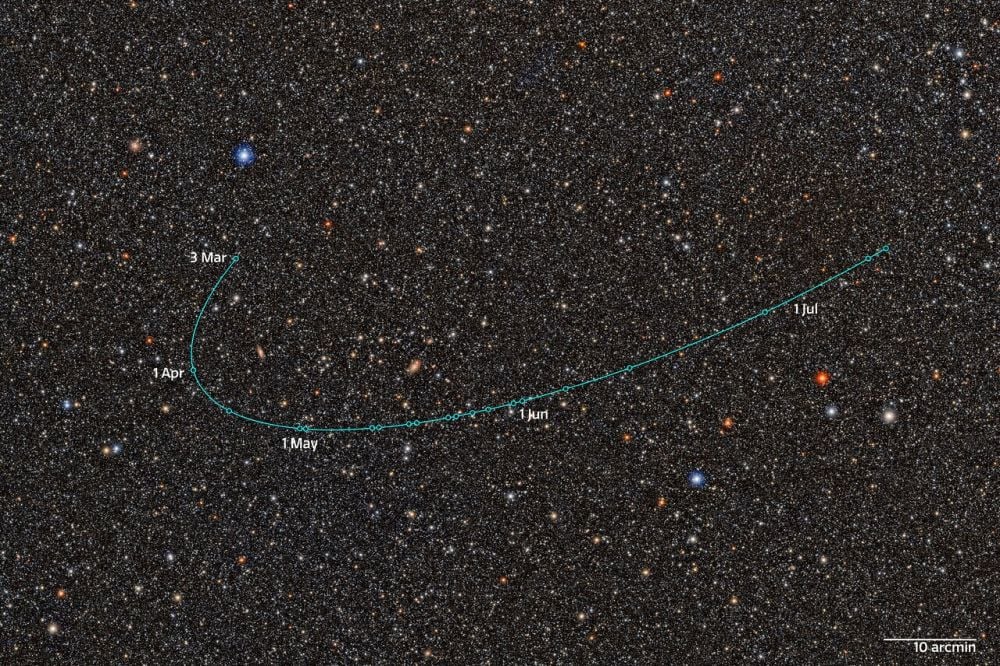
The Vera Rubin Observatory has detected its first dwarf planet candidate, 2026 ED138, in observations taken before the start of its primary mission. Matthew Holman, a senior astrophysicist at the Center for Astrophysics | Harvard & Smithsonian, discovered ED138 on October 13th while running VRO data through a search algorithm that examines billions of detections.
ED138 orbits about 46 astronomical units from the Sun, placing it beyond Pluto's average distance of 40 au in the realm of Trans-Neptunian Objects. If confirmed as a dwarf planet, it would rank among the largest found beyond Neptune, alongside Makemake, Haumea, and Eris.
Mario Jurić, the Rubin Solar System Lead Scientist at the University of Washington, found 20 additional detections of ED138 in VRO data. The Simonyi Survey Telescope spotted the object 30 times across 20 separate nights between March 4th and July 11th. Additional confirmations came from Dark Energy Camera images dating back to 2016. Combined data traced ED138's orbit over a ten-year period.
ED138's brightness, distance, and albedo indicate a diameter between 600 and 1500 kilometers. Astronomers expect icy objects this large to be round, making them dwarf planets. Its orbit is inclined about 25 degrees from the Solar System's plane, classifying it as a hot-classical Trans-Neptunian Object, meaning Neptune disturbed its orbit.
The VRO detects faint, distant objects by imaging the same field repeatedly while algorithms identify even the faintest transients. "Rubin Observatory's super power is the ability to clearly capture movement and change among a vast number of objects and phenomena that humans have never seen before," said Edward Ajhar, NSF Program Director for Rubin Observatory.
Holman noted that objects like ED138 remain rare. "My first reaction was one of excited disbelief," he said. The decade-long Legacy Survey of Space and Time will image the southern sky repeatedly, bringing distant worlds hidden in previously unsurveyed regions within reach.