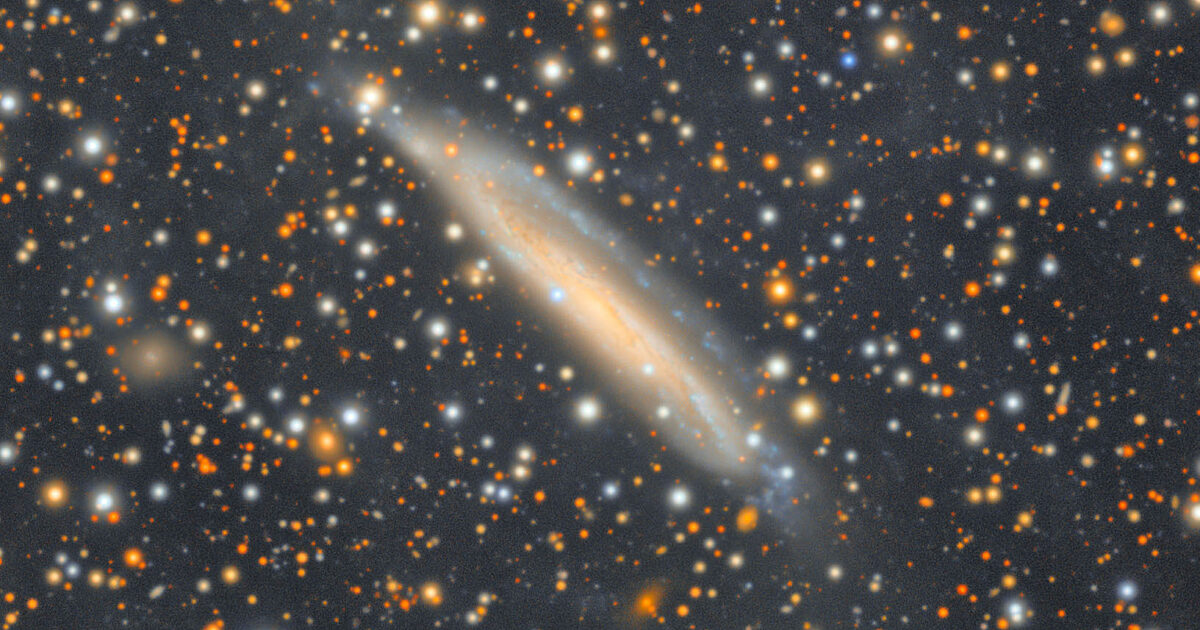
# An Ocean of Stars: Rubin Observatory Launches Revolutionary Universe Survey
The Vera C. Rubin Observatory in Chile has begun operations on what may become the most comprehensive astronomical survey ever conducted. The facility will systematically scan the entire night sky repeatedly over the next decade, cataloging billions of celestial objects and tracking their changes across time.
The observatory's primary instrument, the Legacy Survey of Space and Time (LSST), will photograph the sky every few nights using an 8.4-meter telescope equipped with a 3.2-gigapixel camera. This camera captures images spanning an area six times wider than the full moon in a single exposure. Over ten years, LSST will generate roughly 20 terabytes of data nightly, creating a time-lapse movie of the universe that reveals how objects evolve, move, and interact.
Named after the astronomer who discovered evidence for dark matter, the Rubin Observatory transforms how humanity tracks dynamic phenomena across the cosmos. The survey will detect transient events like supernovae, gamma-ray bursts, and gravitational wave sources. It will identify variable stars, track exoplanet discoveries, and monitor the behavior of distant quasars. The dataset becomes immediately available to the global astronomical community, democratizing access to observations that would have required dedicated telescope time in previous decades.
Planetary protection forms a core component of the mission. LSST will discover and characterize near-Earth asteroids with unprecedented efficiency, identifying potentially hazardous objects years or decades before they approach Earth. Current surveys detect perhaps one percent of dangerous asteroids. Rubin's capabilities will change that ratio dramatically, providing Earth with advance warning of impacts and enabling planetary defense strategies if threats materialize.
The observatory sits at 2,682 meters elevation in the Atacama Desert, one of Earth's driest locations. This extreme remoteness offers exceptional atmospheric transparency, allowing the telescope to detect faint objects that ground-based observatories elsewhere cannot resolve. The dark skies of northern Chile have made this region the global center for major astronomical facilities, including the Very Large Telescope and the Atacama Large Millimeter Array.
Rubin Observatory operates as a public facility managed by the National Science Foundation and the Department of Energy, with contributions from institutional partners and international collaborators. The construction took over a decade and cost approximately $800 million. The survey phase represents the culmination of decades of planning by astronomers worldwide.
Data from LSST will feed artificial intelligence systems designed to identify rare or anomalous objects automatically. Machine learning algorithms will flag novel discoveries without human intervention, allowing astronomers to focus observational resources on the most interesting targets. This approach amplifies human expertise rather than replacing it.
The complete LSST dataset will eventually exceed exabytes in volume. Astronomy has entered the era of big data, where databases contain more observational information than individual astronomers can personally examine. The Rubin Observatory exemplifies this transformation, providing raw material for discoveries that researchers cannot yet imagine.