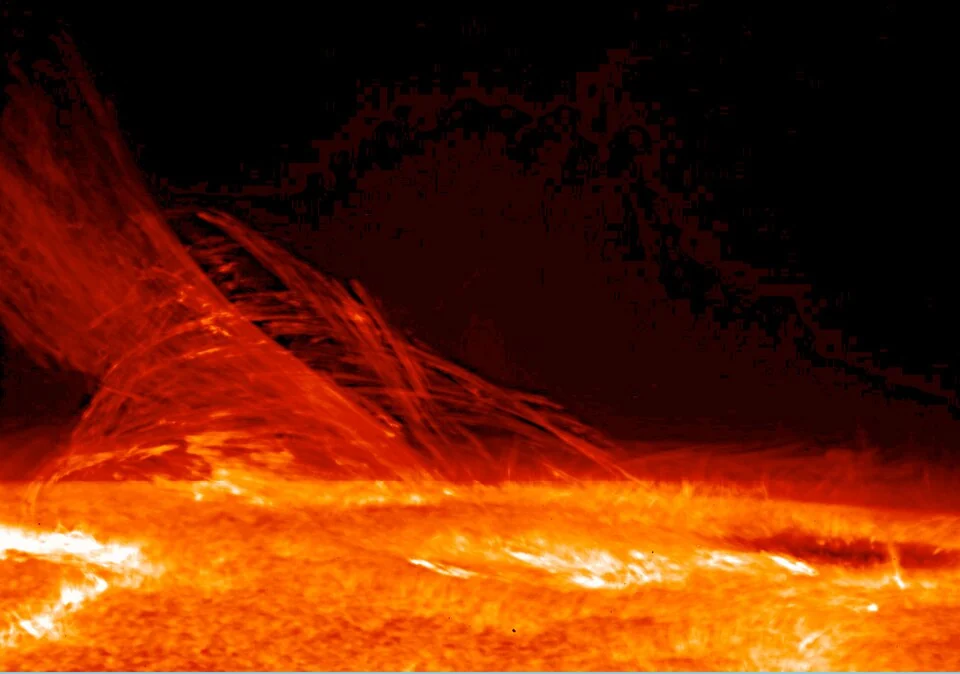
A team from the University of Newcastle, Indian Institute for Astrophysics, and University of Sheffield has proposed a new explanation for spicules, the spike-like plasma geysers that shoot up from the Sun's lower atmosphere at tens of kilometers per second. Rather than acting as individual spinning jets, the researchers suggest spicules are actually a visual illusion created by three-dimensional "curtains" of plasma folding and rippling along magnetic field lines. From Earth's perspective at the solar edge, the overlapping folds appear as discrete, spinning structures.
The discovery emerged from computer simulations using Pencil Code, which modeled magnetohydrodynamics from the Sun's convection zone through the lower corona. The simulations showed that acoustic waves generated by churning plasma beneath the solar surface travel upward as magnetohydrodynamic waves, eventually growing into bow shocks that blast plasma thousands of kilometers into the atmosphere, creating accordion-like folds of plasma curtains.
When researchers aligned the simulated data with observations from the Interface Region Imaging Spectrograph (IRIS) and the Hinode satellite, the strange motions captured by both instruments matched the predicted behavior of twisting, curving curtains rather than individual vertical structures.
The simulations also revealed a previously unknown phenomenon. Automated vortex-detection algorithms identified giant rotating columns of plasma called Coronal Swirling Conduits, or CoSCos. These structures stretch from the solar surface into the corona, spanning hundreds of kilometers across and rotating at up to twenty kilometers per second. CoSCos form either when magnetic field lines snap and break or along the dense edges of plasma curtains, where pressure and density differences generate rotating vortices. As spicule sheets lose energy and descend back toward the surface, these massive tornadoes pull them back up into the corona, potentially contributing energy that powers the solar wind and heats the corona.