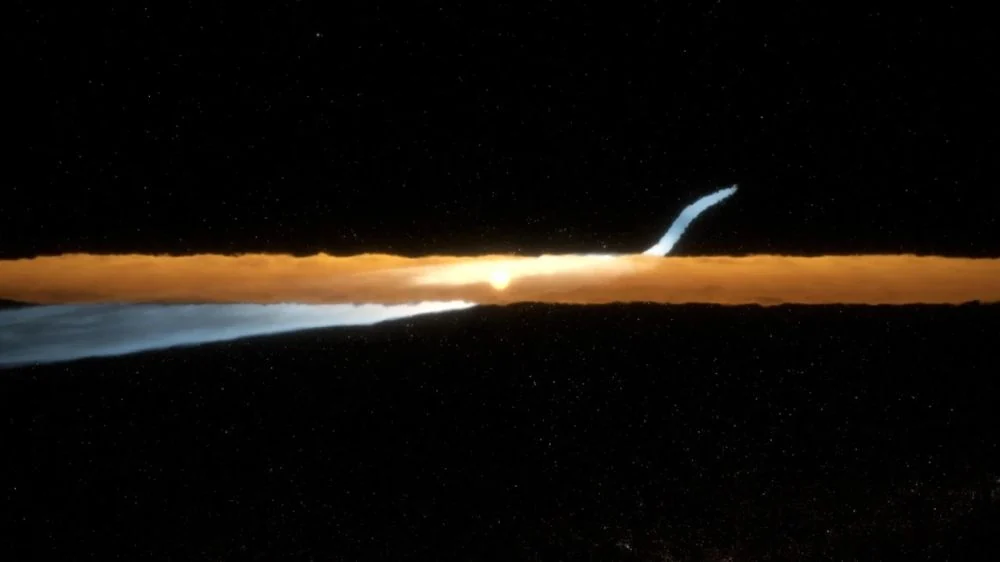
Astronomers using the Hubble Space Telescope and the James Webb Space Telescope have identified the cause of the "Cat's Tail," an extended feature in the debris disk around Beta Pictoris, a young star 63 light years away. The feature stretches about 1,000 astronomical units and was created by a collision between two dwarf planets.
Research led by Arin Avsar, a PhD candidate at the University of Arizona's Lunar and Planetary Laboratory, analyzed six epochs of Hubble observations taken between 2012 and 2025. The study, published in The Astrophysical Journal Letters, found that the Cat's Tail consists almost entirely of organic refractory material, carbon-based compounds that absorb visible light and appear black. This composition explained why the feature had been invisible to visible-light telescopes until now, despite appearing clearly in JWST's infrared images.
The organic refractory material is a key indicator of the colliding bodies. The researchers calculated that each parent body must have had a mass of approximately 1 to 3 times that of the dwarf planet Ceres, with radii between 600 and 800 kilometers. These dimensions match dwarf planets found in our own Kuiper Belt, such as Charon and Makemake.
The dust grains in the Cat's Tail are micron-sized and unusually porous. Co-author Kevin Wagner, an assistant research professor at University of Arizona's Steward Observatory, suggested that collision velocities may have been high enough to vaporize carbon grains, which then recondensed as they cooled, creating their porous structure.
The Hubble observations also revealed an asymmetrical warp in the outer dust halo that may result from interactions with Beta Pictoris b, a giant gas planet approximately ten times as massive as Jupiter.