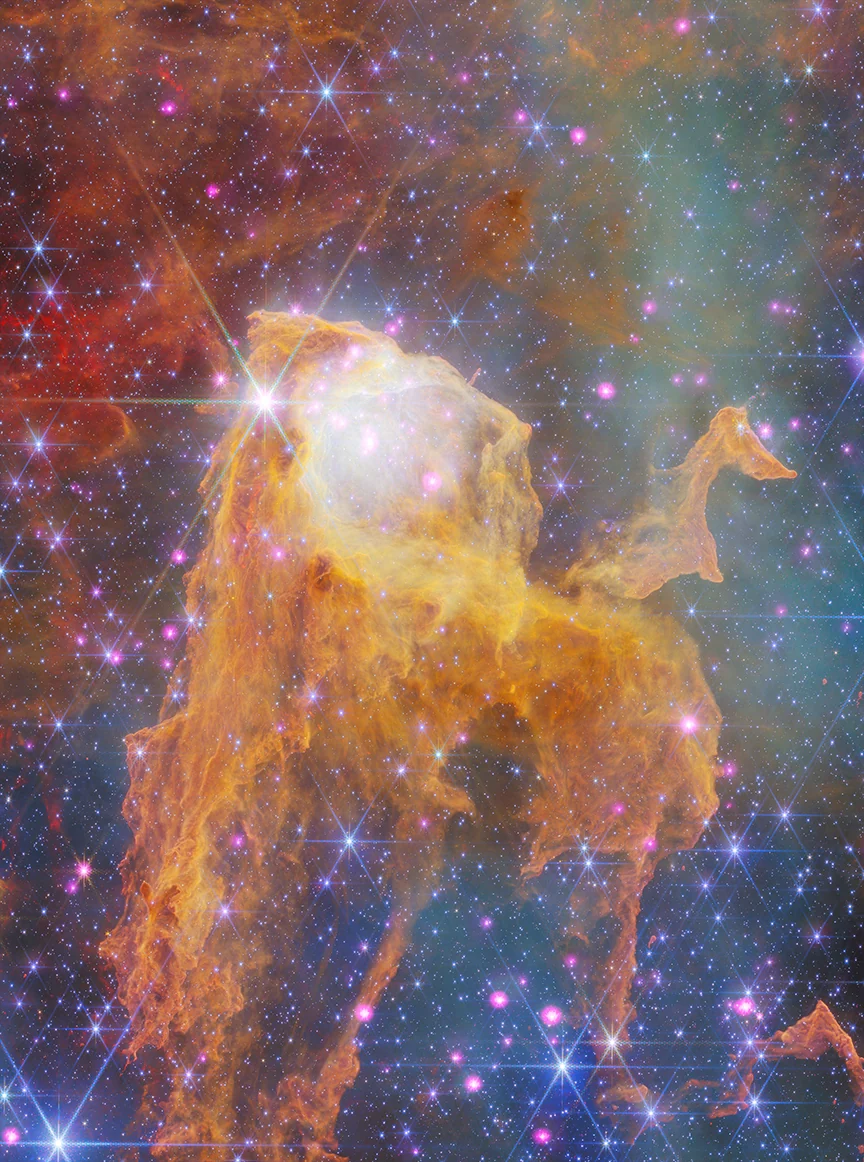
Astronomers using the Chandra X-ray Observatory and the James Webb Space Telescope discovered a wispy cloud in the Carina Nebula that appears isolated but is actively forming new stars. The ghostly-looking region, located more than 7,500 light-years away, revealed its stellar nursery nature when examined in X-rays and infrared light.
The Carina Nebula contains several notable features. Eta Carinae, a binary system with combined brightness around 5 million times that of our Sun, brightens and dims periodically, likely due to dust clouds around the stars. The binary experienced a major outburst called the "Great Eruption" in the 1840s and continues smaller outbursts. Its primary star, a luminous blue variable, is expected to eventually explode as a supernova.
The nebula also harbors the Keyhole Nebula, a dark molecular cloud spanning about 7 light-years, and Trumpler 14, an open cluster of more than 2,000 OB-type stars. These massive stars in Trumpler 14 range in age from about 300,000 to 500,000 years old.
Ionizing radiation from Eta Carinae and young stars shapes the ghostly nebula's materials into comet-like structures called cometary globules. Similar knots appear in other star-forming regions and planetary nebulae where stellar winds collide with ejected material.