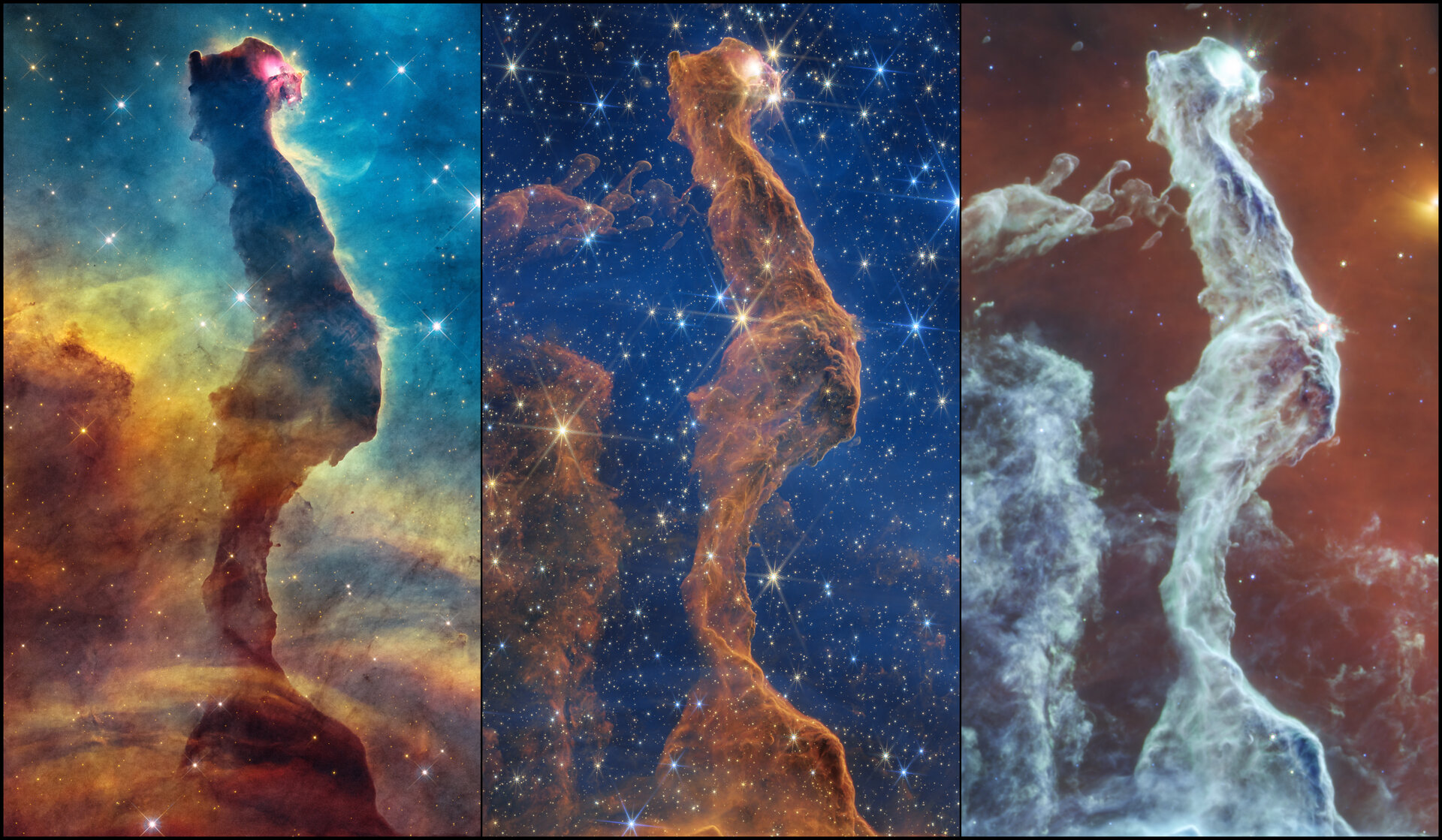
The Hubble and James Webb Space Telescopes have observed a star-forming region within the Carina Nebula, located 7,500 light-years from Earth, nicknamed the Cat's Head Nebula for its feline silhouette.
Hubble's visible-light imagery reveals the structure as a dark, elongated dust pillar with hints of young forming stars. The cat's glowing red eye likely marks a young star partially embedded in dust. A bright yellow ridge along the filament's right edge shows gas illuminated and ionized by ultraviolet radiation from nearby massive stars, indicating photoevaporation is occurring.
Webb's infrared observations penetrate the dust to expose hidden details. In near-infrared light, the nebula becomes more transparent, revealing a dense scattering of blue and yellow stars and delicate wisps of dust and gas on the cat's left. A faint jet-like feature near the cat's belly may indicate an outflow from a young star.
Webb's mid-infrared imagery shows emission from warm dust and polycyclic aromatic hydrocarbons, carbon-based molecules excited by starlight. These colors outline intricate structures, including delicate globules and strands particularly evident to the pillar's left.
The Cat's Head Nebula's distinctive shape has been sculpted by intense ultraviolet radiation and winds from massive stars in the region. Denser material within the pillar resists erosion by stellar feedback, though the nebula remains temporary and will eventually disperse.