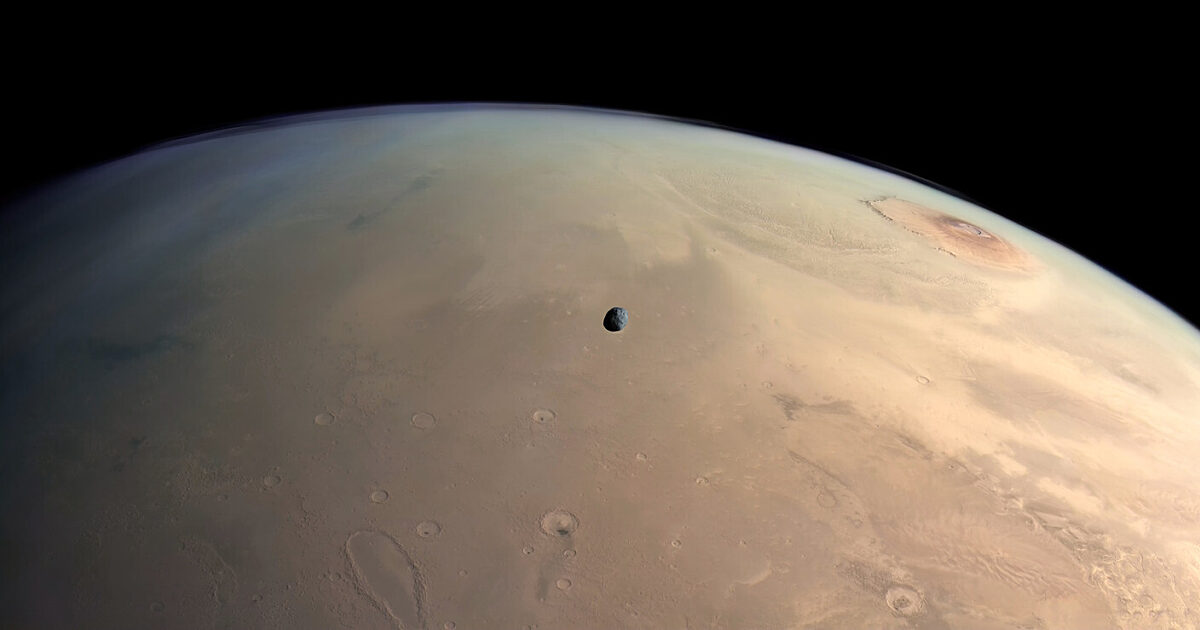
JAXA's Martian Moons eXploration mission will launch as soon as November 2026 to accomplish what no spacecraft has attempted before: sample collection from Phobos, the larger of Mars' two moons. The mission includes contributions from NASA, ESA, France's CNES, and Germany's DLR.
MMX will capture detailed images and spectra of Phobos, deploy a small rover for close analysis, and collect 10 grams of Phobos' regolith using two sampling systems. One system is a drill core reaching 2 centimeters deep. The other is the PlanetVac pneumatic sampling system funded by Planetary Society members.
The samples could resolve decades-old questions about Phobos' origin. Scientists debate whether Phobos and Mars' other moon, Deimos, are captured asteroids from the outer Solar System or debris from Mars' formation. Visible and near-infrared spectral data suggest Phobos resembles ancient asteroids, but recent thermal infrared images show similarities to fine-grained Martian basalt.
MMX-participating scientist Christopher Edwards noted that both hypotheses have implications for how the inner Solar System assembled and water reached Earth. If Phobos is a captured asteroid, it could reveal primordial materials like organic molecules, minerals, and ices present during rocky planet and life formation. If the material comes from early Mars' crust, the samples would represent the best-preserved samples ever obtained from the Mars system.
ESA's ExoMars Rosalind Franklin rover, with renewed NASA support including a confirmed 2028 launch, will land in Oxia Planum, a clay-rich region adjacent to ancient channels. ExoMars project scientist Jorge Vago explained that Mars lacks plate tectonics, allowing study of early planetary evolution and conditions for life to emerge.