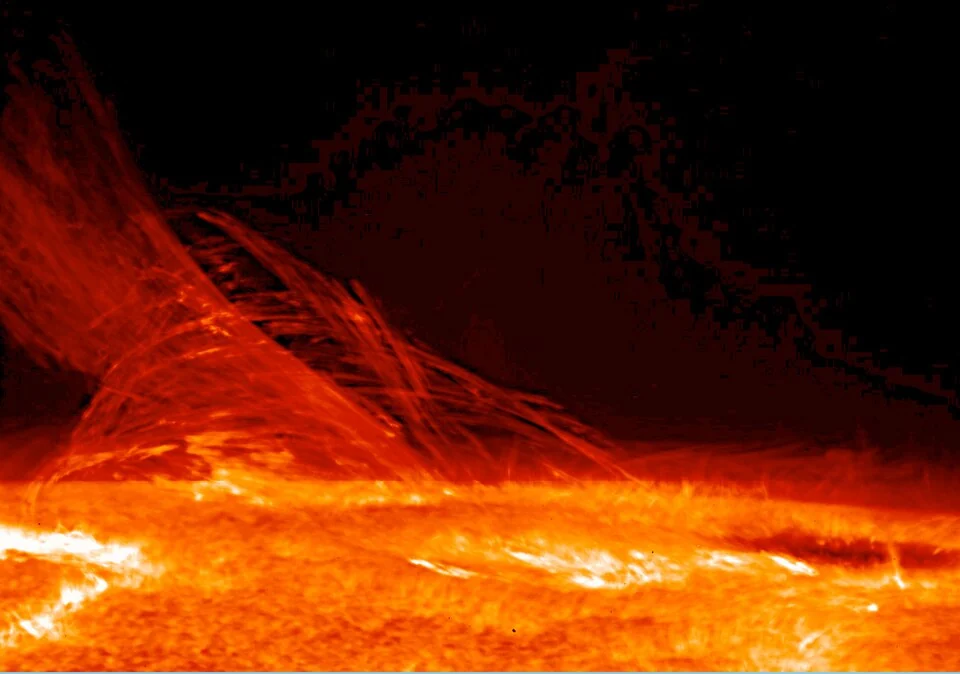
For decades, astronomers have watched spicules—those spike-like geysers of plasma shooting up from the Sun at tens of kilometers per second—as if observing individual cylinders of hot gas. A groundbreaking paper from researchers at the University of Newcastle, Indian Institute for Astrophysics, and University of Sheffield suggests we've been fundamentally misinterpreting what we're seeing. The spicules aren't discrete jets at all. They're an optical illusion created by our limited two-dimensional perspective of three-dimensional magnetic structures. This discovery matters because it reshapes our understanding of how the Sun's atmosphere functions.
What makes this finding particularly compelling is how it was achieved. Rather than relying on data from newer spacecraft like Solar Orbiter or the Parker Solar Probe, the research team used the Pencil Code simulation tool to model magnetohydrodynamics from the convection zone beneath the solar surface all the way up through the lower corona. The simulation revealed that acoustic pounding from churning plasma granules launches magnetohydrodynamic waves upward, which grow into massive bow shocks that eventually blast giant 'curtains' of plasma thousands of kilometers into the Sun's atmosphere. When viewed from above, these plasma curtains appear accordion-like and folded. But when a telescope observes them from the Sun's edge—the only perspective we typically have—the integration of those folds creates the illusion of individual spicules.
The researchers had real observational data to validate their simulation. Data from the Interface Region Imaging Spectrograph (IRIS) and the Hinode satellite, originally launched in 2006 and 2013 respectively, showed spicules undergoing bizarre motions. When aligned with the simulated data, those motions matched perfectly with a curving, twisting curtain model. This convergence between simulation and observation provides strong evidence that our traditional understanding has been incomplete.
Perhaps more intriguing than solving the spicule mystery is the discovery of an entirely different phenomenon: Coronal Swirling Conduits, or CoSCos. These are giant columns of rotating plasma hundreds of kilometers across, spinning at up to twenty kilometers per second. The researchers identified two creation mechanisms: one from snapping magnetic field lines, and another from pressure and density differences along spicule curtain edges. Crucially, CoSCos appear to transport energy from the surface into the corona, potentially contributing to the long-standing mystery of why the Sun's corona is so much hotter than its surface.
This research demonstrates that answering fundamental questions about our Sun doesn't always require launching new spacecraft. Computer simulations, when properly validated against real observational data from existing instruments like Hinode and IRIS, can reveal hidden truths about cosmic phenomena. As the researchers continue studying this process, we should expect more insights from the growing arsenal of solar observation equipment currently studying our star.