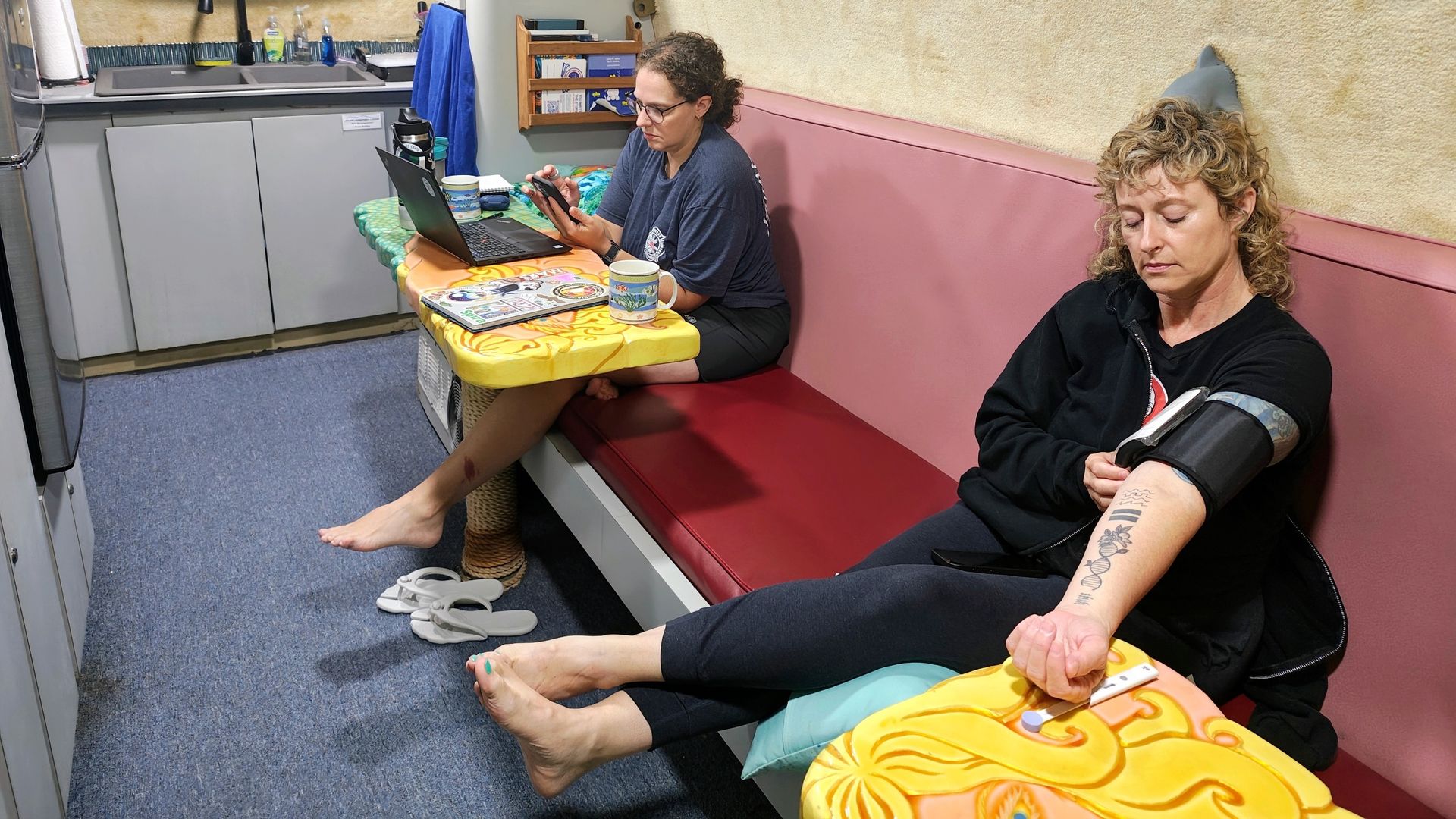
Dr. Michaela Musilova and her crew completed a five-day underwater mission at Jules' Undersea Lab near Key Largo, Florida, living and working 22 feet beneath the surface to simulate conditions on the International Space Station. The four-person SEA STAR crew conducted research relevant to long-duration space missions while in saturation, the physiological state achieved when the body absorbs the maximum amount of inert gas at a specific depth and pressure.
Musilova's cognitive study examined whether reaction times and mental abilities changed under pressure, done in collaboration with the Center for Hyperbaric Medicine at the University of Ostrava in the Czech Republic. The crew grew microgreens seeds under two different pressure conditions and found that seeds exposed to sudden pressure changes experienced barotrauma. Paul Bakken studied how internal pressure in logistical transfer containers responds to environmental pressure changes. Jenn Pint worked with Interstellar Performance Labs to develop a system for analyzing environmental and crew interaction factors during simulated space missions. The team also tested environmental sensors created by high school and university students in Slovakia and performed neutral buoyancy experiments during underwater spacewalks.
The crew performed environmental conservation work using an underwater vacuum device and conducted educational outreach, giving a tour of their habitat to the team at Cosmic Region, a simulated space station in Slovakia. The return to the surface required a gradual ascent around the lagoon to allow their bodies to adjust to lower pressure and avoid decompression-related problems.