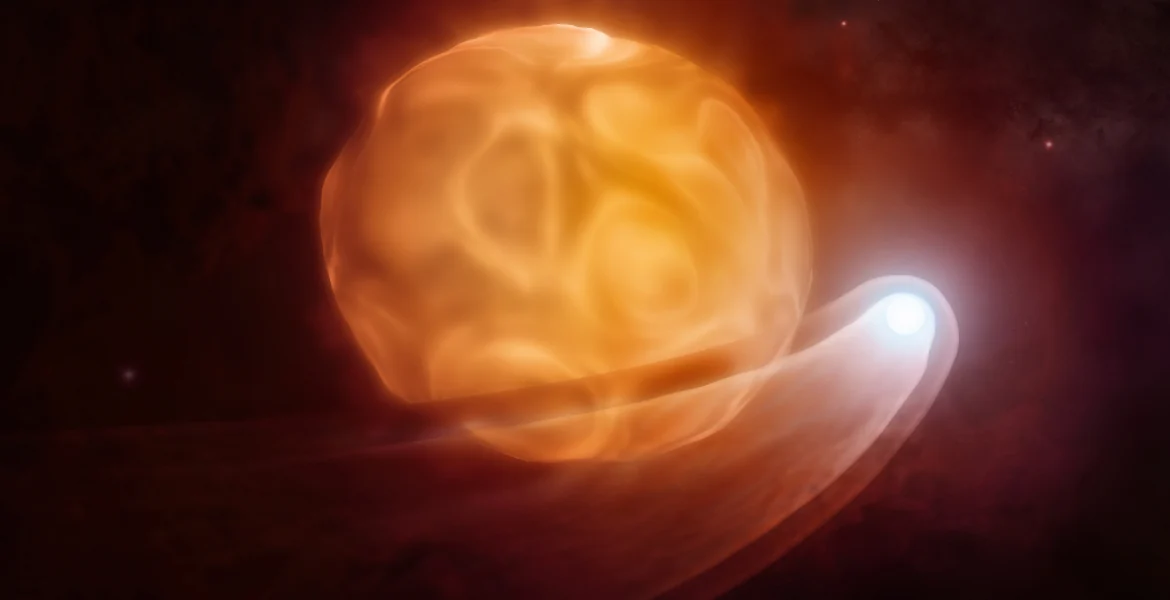
Betelgeuse, the red supergiant marking Orion's shoulder, shows signs of atmospheric disturbance from a close companion star called Siwarha, according to new observations from the Very Large Array (VLA) and the Atacama Large Millimeter-submillimeter Array (ALMA).
The companion star cannot be observed directly, but radio observations reveal that Betelgeuse's atmosphere becomes egg-shaped at times, then returns to a more circular appearance. This cycling matches what would happen if a nearby mass were tugging on the star as it orbits. Siwarha orbits less than three times Betelgeuse's radius, well within the red supergiant's diffuse outer atmosphere.
Betelgeuse has two brightness cycles. One spans about 425 days. A second pattern repeats every 5.9 years. This longer cycle matches the egg-shaped distortion and the suspected orbital period of Siwarha. The study, published in The Astronomical Journal, provides the strongest evidence yet that Betelgeuse is a binary star system.
The red supergiant itself has a mass only 14 times the Sun's but swells to more than 640 times the Sun's diameter. Its atmosphere extends wider than Mars's orbit. The presence of Siwarha means the brightness and temperature variations observed at Betelgeuse result not just from the star itself, but also from its companion's gravitational pull on its outer layers.