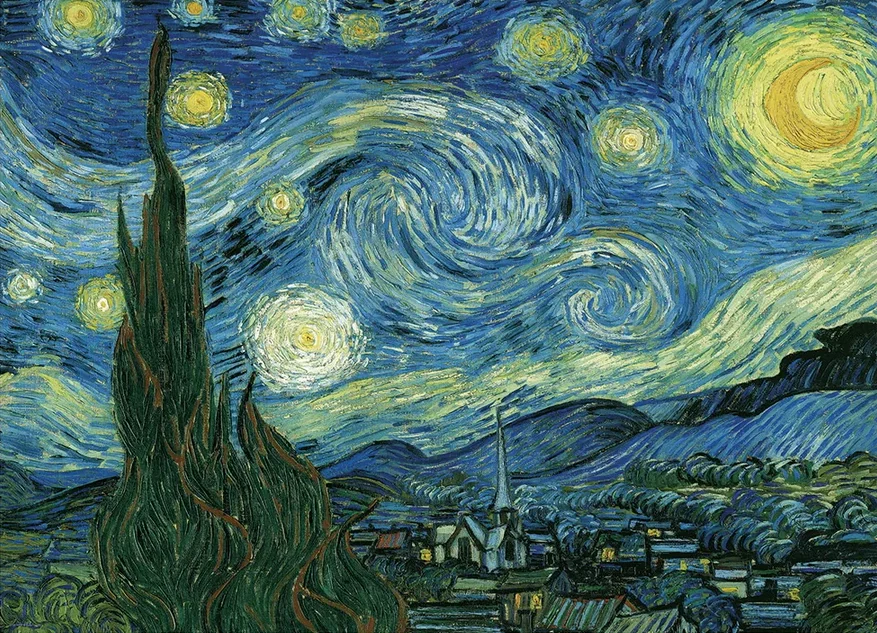
A study published in Scientific Reports used observational geometry to match the night sky in Vincent van Gogh's "The Starry Night" to a specific date. Researchers from SLLAB, a South Korean telescope manufacturer, and Kyung Hee University's School of Space Research identified the Hyades star cluster, Venus, and a crescent Moon in the 1889 painting.
The team, led by Elijah Jeong-hyun Kim, CEO of SLLAB and a Ph.D. candidate at Kyung Hee University, narrowed the painting's date to July 22nd, 1889. On that date, the Moon appeared as a crescent and the Hyades cluster rose in the east alongside Venus in the Taurus constellation. The traditional dating of June 18th, 1889, based on a letter van Gogh wrote to his brother, placed the Moon in a waning gibbous phase, which did not match the painting.
Kim conducted field trips to France in 2019 to verify van Gogh's field of view from Saint-Rémy and to locate where van Gogh drew the landscape before painting it. The team used statistical shape analysis to confirm that the five central stars in the painting corresponded to the Hyades cluster, a match that appeared even stronger in a pen drawing van Gogh made after finishing the painting.
"To an observational astronomer, the cluster of stars in The Starry Night is the Hyades in Taurus," Kim said. "But the moment I read the earlier studies explaining it as Aries, I heard the painting calling to me."
The results suggest van Gogh based the sky on actual observation rather than pure impressionist feeling. The team applied the same methods to "Café Terrace at Night" (1888) and found a possible match to the Summer Triangle asterism. Kim said the work opens the door to multidisciplinary collaborations between astronomers and art historians examining other historical night paintings.