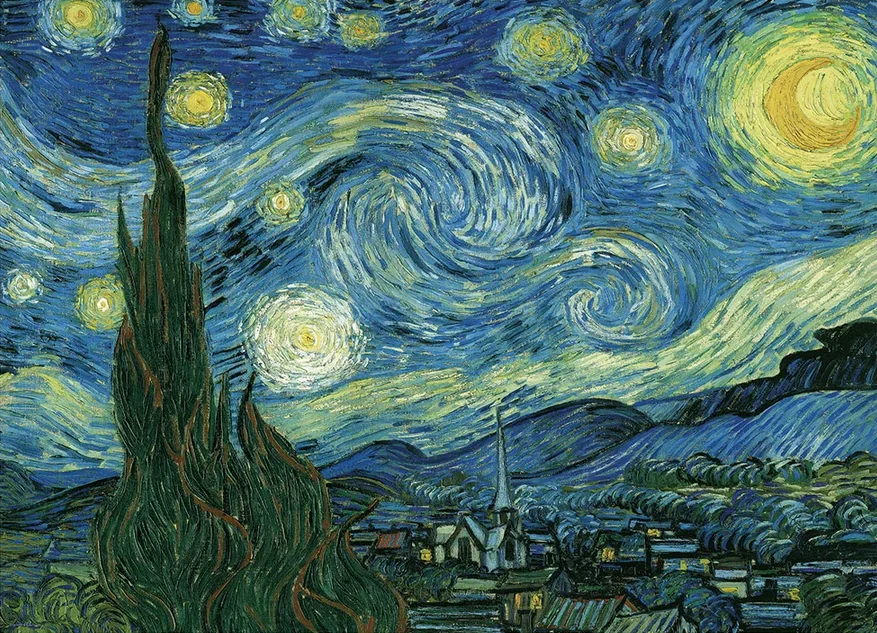
For over a century and a half, art historians have debated whether Vincent Van Gogh's The Starry Night was a spontaneous creative outpouring or something grounded in observable reality. A new study published in Scientific Reports by SLLAB and the School of Space Research at Kyung Hee University finally settles this question—and demands we reconsider how we approach historical artworks at the intersection of science and culture.
The research, led by Elijah Jeong-hyun Kim (CEO of SLLAB and Ph.D. candidate at Kyung Hee University's School of Space Research), resolves a decades-long impasse that began when UCLA art historian Albert Boime and Harvard astronomer Charles Whitney first analyzed the painting's astronomical aspects in 1984 and 1986 respectively. Their conflicting conclusions left scholars at an impasse. Kim's team, using observational geometry and on-site field work conducted in France in 2019, provides compelling evidence that the crescent Moon, Venus, and the Hyades star cluster visible in the painting align with the night sky of July 22nd, 1889—not the traditionally assumed June 18th, 1889.
What makes this finding particularly significant is how it reframes Van Gogh's working method. By locating the exact spot in Saint-Rémy where Van Gogh drew the landscape in preparation for his painting and conducting statistical shape analysis on the central stars, Kim's team demonstrated that the sky was based on actual observation rather than pure impressionist feeling. The team's discovery that Van Gogh's seizure likely began in late July, not on the earlier June date, further supports this revised chronology drawn from cross-analysis of original French and Dutch letters.
The implications extend far beyond resolving one painting's mystery. Kim explicitly stated his hope that this work would 'prompt a renewed, multidisciplinary look at the sequence and working methods of the Saint-Rémy paintings.' The team has already applied the same methodology to Café Terrace at Night (1888) and identified a possible match to the Summer Triangle asterism, demonstrating that these methods could revolutionize how we analyze other historical night paintings.
Museums, art historians, and the public should embrace this convergence of astronomy and art history. Van Gogh emerges not as a purely visionary artist working from imagination, but as an observer deeply engaged with the actual cosmos. Recognizing The Starry Night as a scientifically grounded work—while maintaining its undeniable artistic brilliance—opens pathways for collaborative research that honors both disciplines and deepens our understanding of how great artists have perceived and recorded their world.