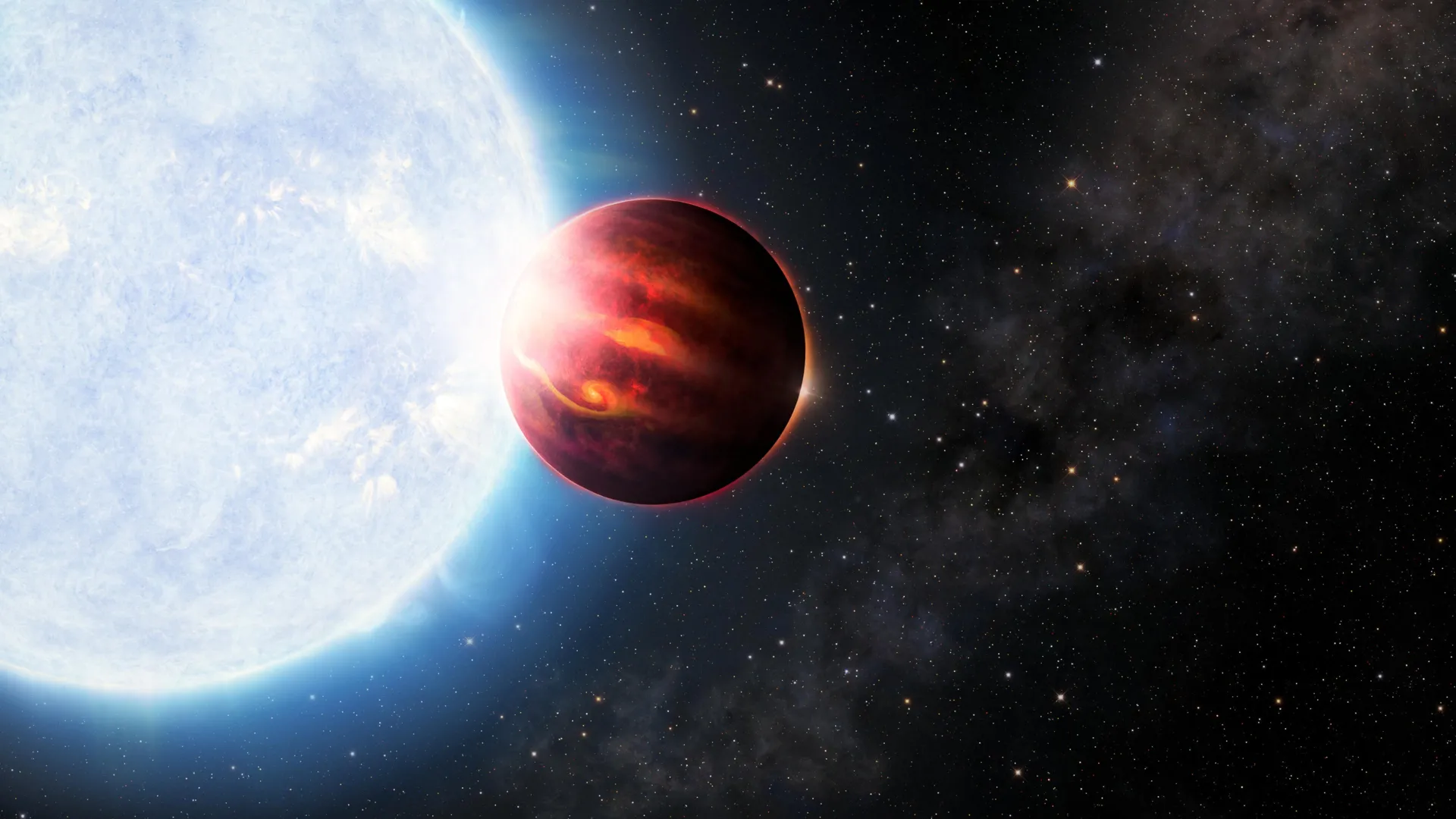
An international research team led by Jorge Antonio Sanchez at Arizona State University used the Immersion GRating INfrared Spectrograph (IGRINS) on the Gemini South telescope in Chile to observe WASP-189b, an ultra-hot Jupiter located 320 light-years away in the Libra constellation. The observations marked the first simultaneous measurement of gaseous magnesium and silicon in an exoplanet's atmosphere.
The researchers found that the ratio of magnesium to silicon in WASP-189b's atmosphere closely matches the ratio in its host star. This discovery provides direct observational evidence for a long-standing assumption that planets retain the chemical proportions of the disk from which they formed, since stars and their surrounding protoplanetary disks originate from the same cloud of material.
"WASP-189b gives us a much-needed observational anchor in our understanding of terrestrial planet formation since it offers a measurable quantity that validates the presumed resemblance of stellar composition and the proportion of rocky material around host stars used to form planets," Sanchez said.
The finding has implications beyond planetary formation. By studying stellar chemistry, astronomers may estimate the amounts of rock-forming materials available to planets, which influence internal structure, geological activity, and chemical environment. These factors can affect whether conditions suitable for life might develop. Earth's plate tectonics, magnetic field generation, and chemical cycling all depend on its elemental composition and affect habitability.
Michael Line, an associate professor at ASU and study co-author, noted that "ground-based, high-resolution spectrographs" currently provide the necessary spectral resolution to detect such elements in distant planetary atmospheres. The team expects future observations using multiple wavelengths to reveal additional elements and provide a more complete picture of exoplanet chemical compositions.