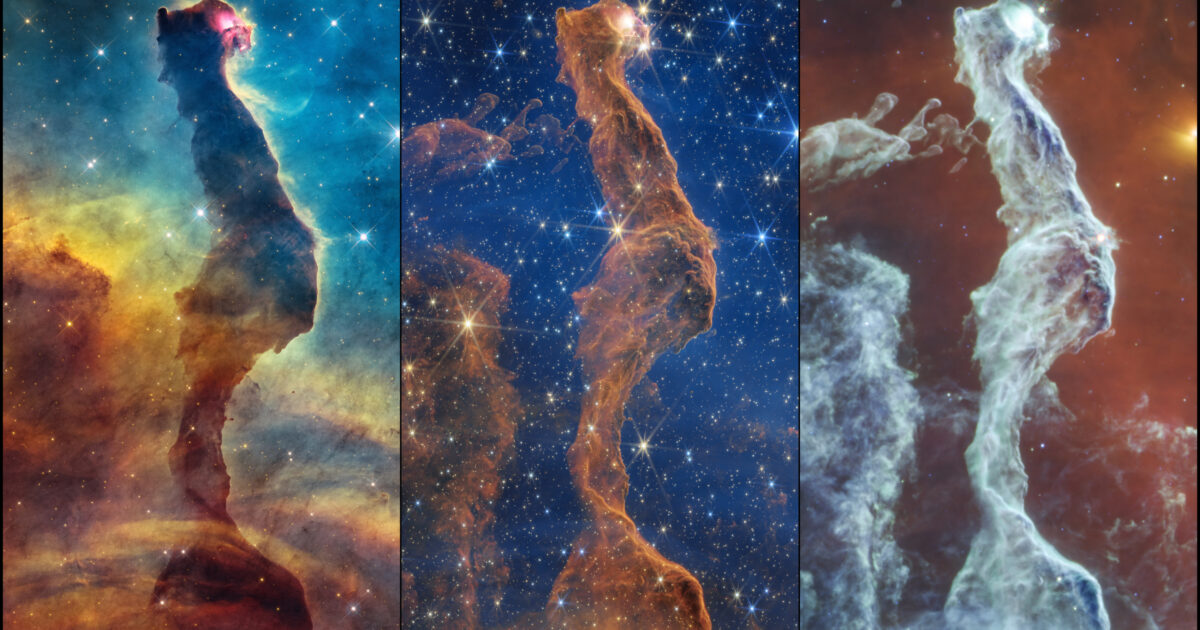
Images from the James Webb Space Telescope and Hubble Space Telescope show the Cat's Head Nebula, a region of gas and dust in the larger Carina Nebula roughly 7,500 light-years away. The Hubble image captured visible wavelengths on the left, while JWST recorded near-infrared and mid-infrared wavelengths in the center and right images respectively.
The Carina Nebula contains Eta Carinae, a star that briefly became the second brightest star in the sky in 1843. An eruption drove the brightness increase, but it was not a supernova. Astronomers have not reached consensus on what caused the event.
NASA's Neil Gehrels Swift Observatory reentered Earth's atmosphere on November 4 after more than 20 years of science operations. The gamma-ray burst observatory burned up as atmospheric drag brought it down. An earlier mission to reboost the telescope to a safer orbit was unsuccessful.
China announced plans to land taikonauts on the Moon. The chief designer of the Chinese lunar exploration program outlined a strategy in which a lunar lander and crew spacecraft will launch separately and dock in lunar orbit, after which two taikonauts will descend to the Moon and return.
NASA's Voyager 1 will become the first human-made object to travel one light-day from Earth this month. A livestream event scheduled for November 18 at 8:00 p.m. ET will feature Voyager Project Manager Suzanne Dodd, Mission Manager Kareem Badaruddin, and Project Scientist Linda Spilker from NASA's Jet Propulsion Laboratory. Space artist Don Davis will reveal a new work commemorating the achievement.
NASA's Dragonfly mission launches to Saturn's moon Titan in 2028 carrying a chip with the names of everyone who signs up through an online form.