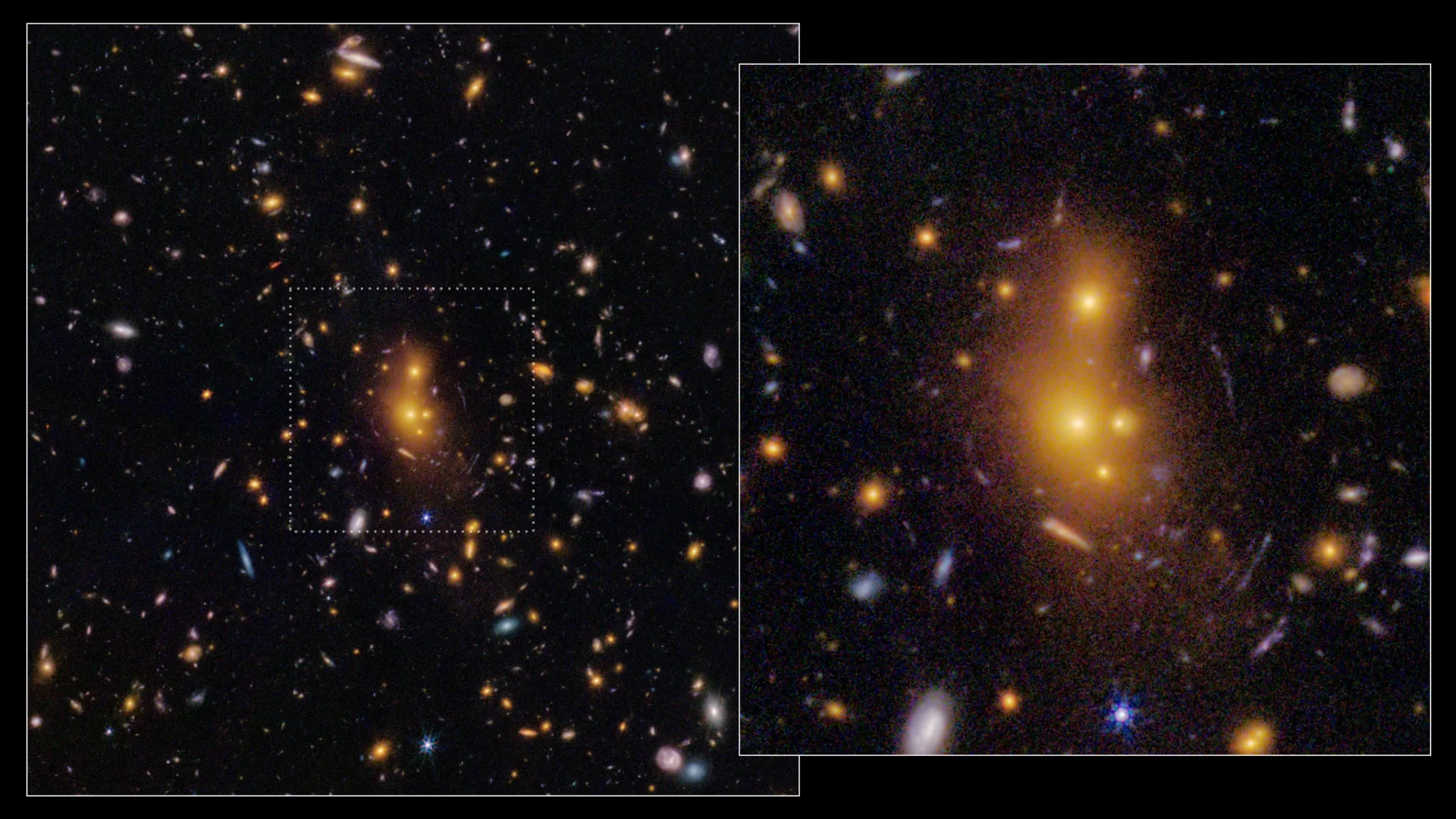
NASA's James Webb Space Telescope has revealed that XLSSC 122, a galaxy cluster 10.4 billion light-years away, displays unexpected density and maturity for the early universe. The cluster holds the record as the most distant galaxy cluster known to show strong gravitational lensing, a phenomenon that bends light from background galaxies and allows scientists to measure mass distribution.
Three studies led by researchers at IPAC, Caltech's astrophysics and planetary science center, were presented at the American Astronomical Society's 248th meeting on June 17, 2026. The findings challenge current cosmological models. XLSSC 122 existed during "cosmic noon," roughly 10 billion years ago, when the universe experienced its most intense star formation. Yet the cluster packed an unusually large amount of mass into its central region, faster than standard models predict.
"XLSSC 122 is one of the first clusters we know of that formed in the universe, and it has a mass concentration that doesn't agree with our cosmological model predictions," said Kyle Finner, lead author and staff scientist at IPAC.
The gravitational lensing comes primarily from dark matter, an invisible substance that accounts for most of the bending effect. By combining strong lensing measurements with weak lensing analysis and X-ray and radio observations, the team determined that XLSSC 122 is still undergoing a merger, with galaxies continuing to combine as the larger structure takes shape.
Webb also detected intracluster light, the earliest known observation of this faint glow from stars scattered between galaxies. The distribution of this light closely matches the dark matter distribution inferred from strong lensing, suggesting that visible starlight could serve as an indicator of where invisible dark matter concentrates.