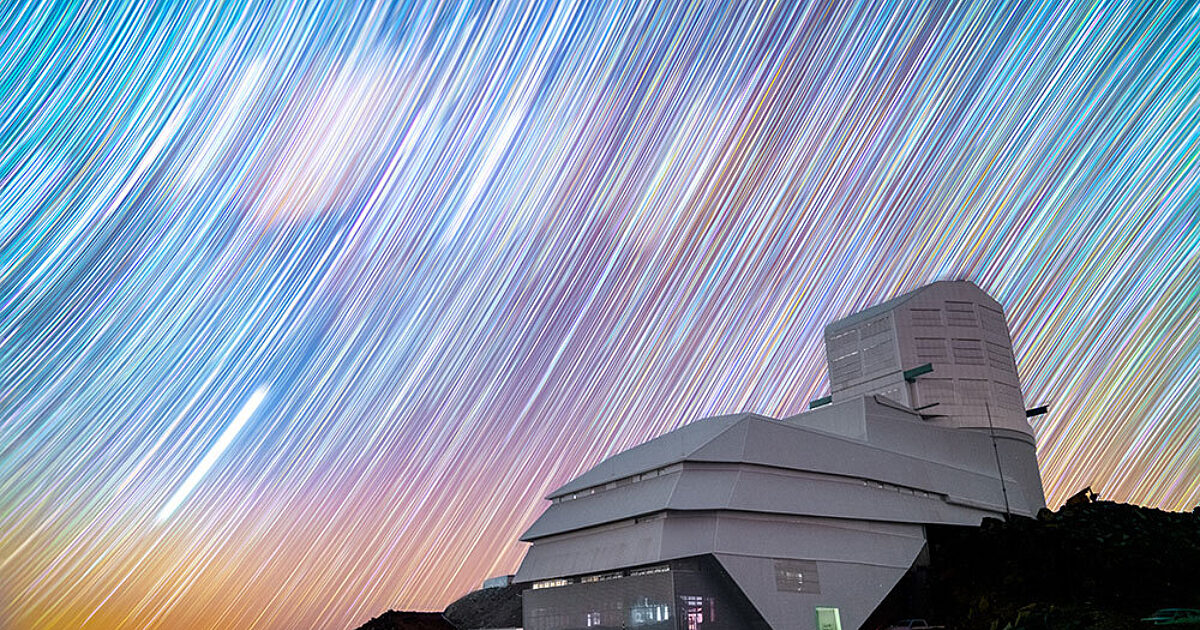
The Vera C. Rubin Observatory began its Legacy Survey of Space and Time (LSST) on June 29, 2026, from atop Cerro Pachón in northern Chile. Over 10 years, the telescope will photograph the entire visible sky repeatedly, revisiting each patch about 800 times to create an ultra-wide, ultra-high-definition time-lapse record of the universe.
By June 2036, Rubin expects to catalog approximately 20 billion galaxies, 17 billion stars, and 6 million Solar System objects. The repeated observations allow the telescope to detect motion and change, such as asteroids drifting through space or stars brightening or exploding. When such changes occur, Rubin sends alerts to other telescopes for follow-up observations.
Rubin's primary science goals include understanding dark matter and dark energy, creating an inventory of the Solar System, mapping the Milky Way, and studying objects that change position or brightness over time. The telescope is a joint project of the U.S. National Science Foundation and the U.S. Department of Energy's Office of Science.
When Rubin released its first images on June 23, 2025, from about 10 hours of test observations, the team announced discovery of 2,104 previously unknown asteroids. These included seven near-Earth objects, 11 Jupiter Trojans, and nine objects beyond Neptune. None of the near-Earth objects found so far pose a threat to Earth.
Rubin is expected to discover 5 to 10 times more Solar System objects than were previously known. Scientists have cataloged most near-Earth asteroids larger than 1 kilometer across, but only about 40% of those larger than 140 meters. An impact by a 140-meter asteroid could devastate a region. Rubin is projected to raise the detection rate of asteroids that size to 70%.
The observatory is named after Vera C. Rubin, an American astronomer whose work with colleague Kent Ford provided evidence for dark matter. Her research demonstrated that spiral galaxies rotate too quickly to remain intact based on visible matter alone, suggesting the presence of undetected mass. Rubin worked in astronomy from the 1960s through the 1980s and helped open the field to women, conducting observations at facilities that had never officially allowed women before, including Palomar Observatory. The observatory received her name in 2019, three years after her death, making it one of the first major U.S. national observatories named after a woman.