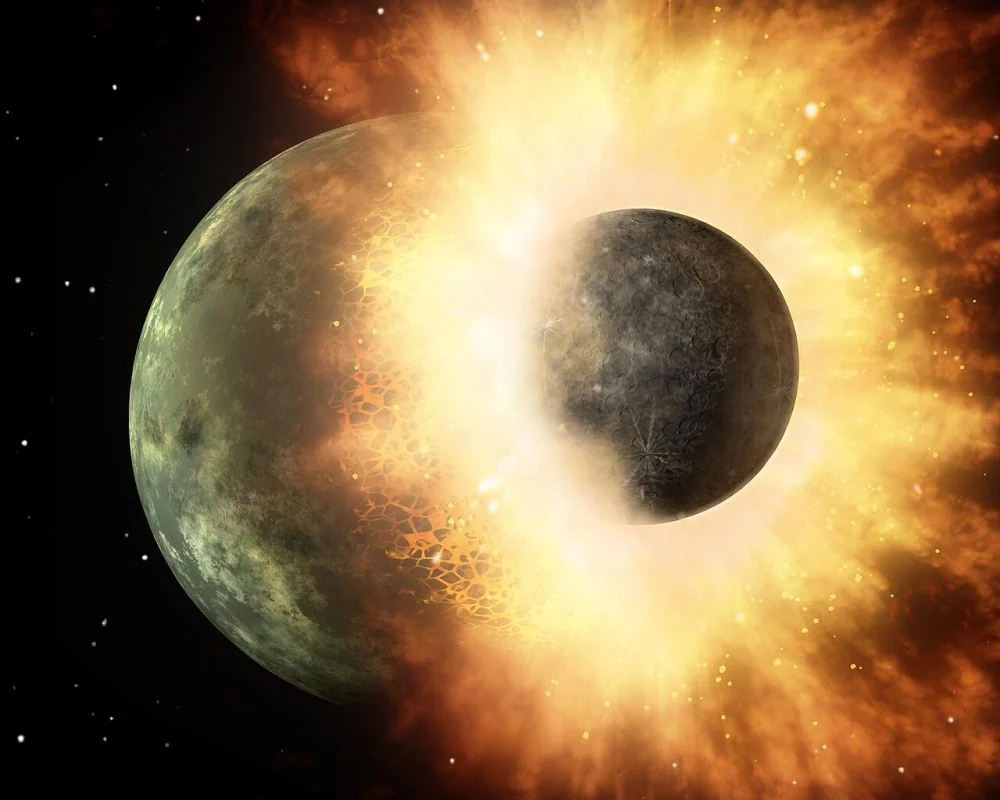
A study published in Nature Astronomy challenges the longstanding assumption that giant impacts during planetary formation drive away atmospheres from young rocky planets. Research by Darius Modirrousta-Galian of Shanghai Jiao Tong University and Jun Korenaga of Yale University shows that massive collisions can actually help planets retain their primordial helium and hydrogen atmospheres.
The researchers found that giant impacts produce two competing effects. Heat from collisions does drive atmospheric escape, but only part of that heat reaches the planet's mantle where it would strip away the atmosphere. Some heat penetrates deep into the planet, and mantle melting absorbs energy as latent heat. Meanwhile, the mass gained from the impacting planetesimal increases the planet's gravitational binding energy across its entire structure. "Whereas the entire accreted mass contributes to the increase in gravitational binding energy, only part of the impact energy raises mantle temperature," the authors explain.
The net result favors atmospheric retention. Planets that experienced more massive impacts grew larger and gained enough mass to hold onto their atmospheres more effectively than smaller planets that faced fewer large collisions.
This mechanism may explain why sub-Neptunes and super-Earths appear in such abundance among detected exoplanets, despite neither type existing in our Solar System. Sub-Neptunes likely formed through larger impacts that allowed them to retain substantial primordial atmospheres, while super-Earths underwent fewer massive collisions and lost their atmospheres to stellar radiation.
"This overturns the decades-old canonical view that giant impacts almost always lead to complete atmospheric loss, demonstrating instead that these collisions can play a crucial role in the formation of sub-Neptunes," Korenaga said.