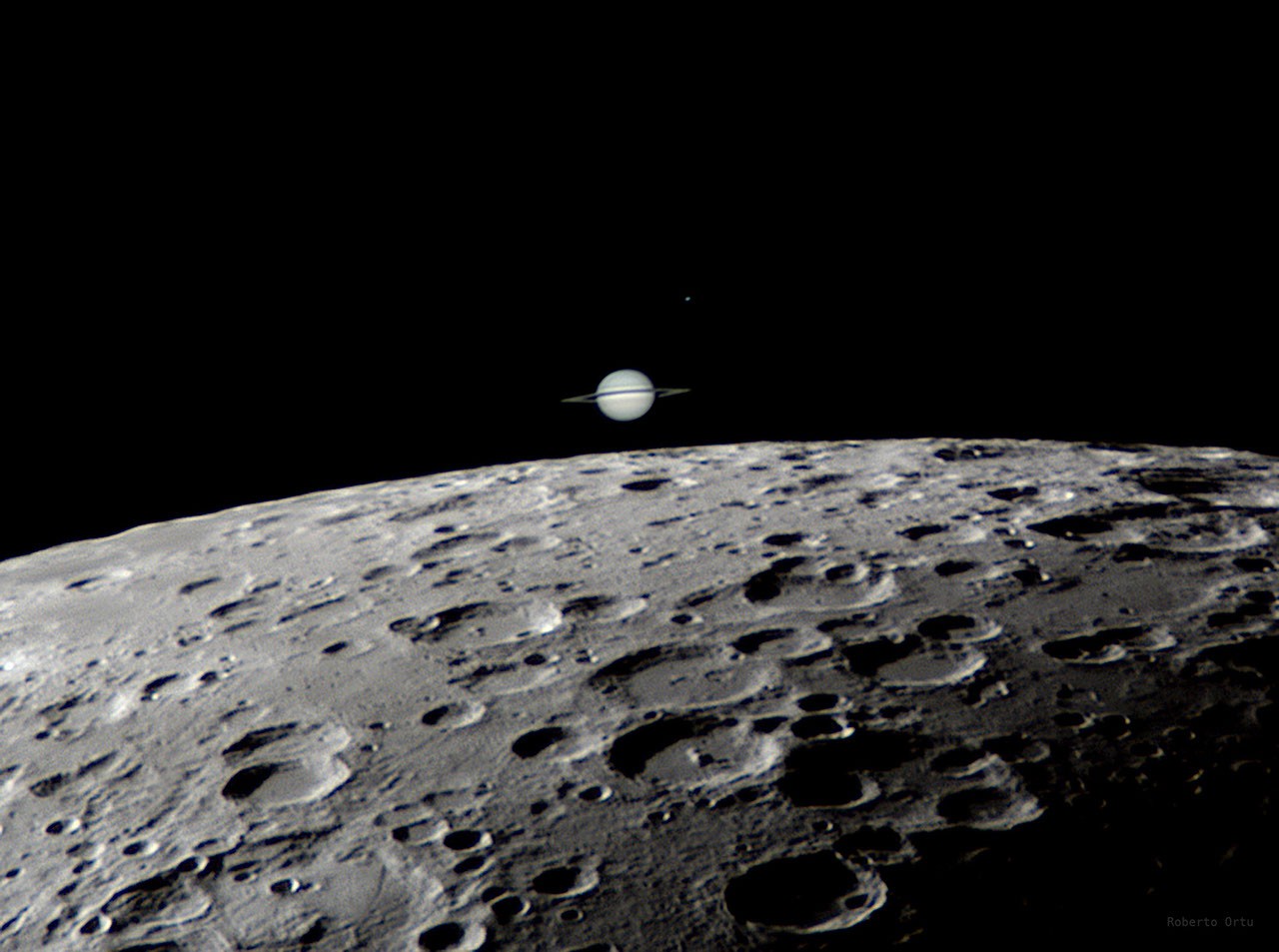
When Earth's Moon moved in front of Saturn in early 2025, creating what astronomers formally call an occultation, it offered a rare celestial spectacle visible along a small swath stretching from Greenland through central Europe and into northern Africa. Yet for most of humanity, this event passed virtually unnoticed. This represents a missed opportunity for science communication and public wonder that the astronomy community must address before the next such occurrence.
The featured image captured from Sardinia, Italy after sunset demonstrates what made this event scientifically valuable: a digital fusion showing Saturn before disappearing, followed by two exposures of the Moon at different lengths. The image also reveals an instructive detail—the bright dot near Saturn is not a moon of Saturn itself, but rather the star 85 Aquarii positioned further behind Saturn than Saturn is behind the Moon. These layered perspectives teach us about cosmic distances and positioning in ways that static diagrams cannot.
What troubles me is not the rarity of such events—we have a clear schedule, with the next occultation visible from somewhere on Earth occurring in 2031. Rather, it is our collective failure to leverage these predictable moments for public astronomical literacy. Unlike supernovae or unexpected meteor storms, occultations can be anticipated years in advance. This predictability should enable robust educational campaigns, viewing parties, and media coverage.
The narrow visibility path—limited to specific regions from Greenland through central Europe to northern Africa—does create genuine observational challenges. However, this constraint should encourage coordinated international efforts and citizen science initiatives rather than acceptance of public indifference. Educational institutions along that path should have mobilized students and teachers to participate in this cosmic alignment.
As we look toward 2031, the astronomy community must treat Saturn's next occultation as a test case for improving public engagement. Professional astronomers should work with media outlets to explain not just what will happen, but why these events matter for understanding our solar system's geometry. When Saturn disappears behind the Moon, we have a three-dimensional lesson written across our sky. We should not let it disappear from public consciousness as well.