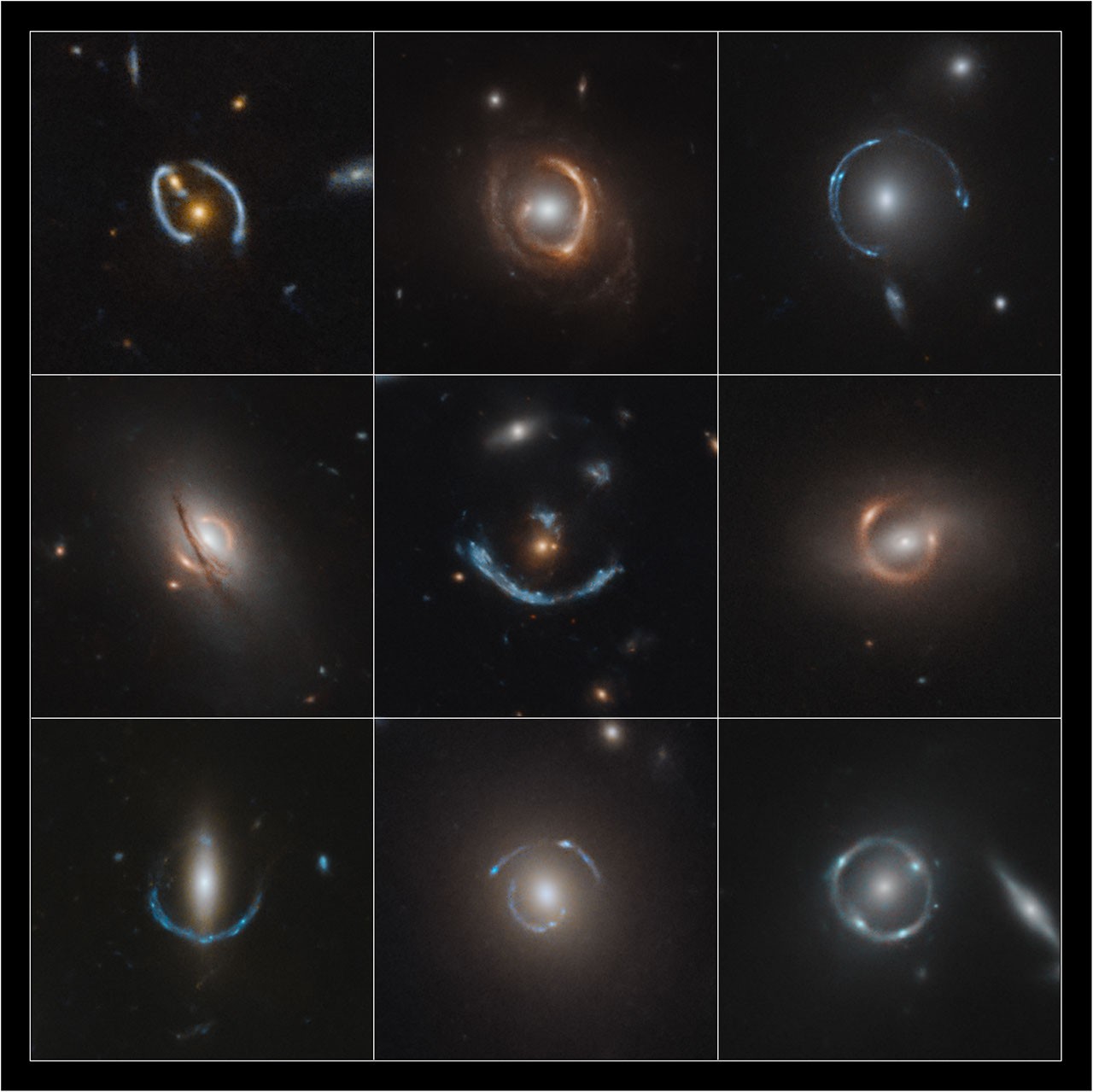
NASA's new gallery of gravitational lenses captured by the Hubble Space Telescope represents far more than a beautiful cosmic photo album. These images demonstrate a fundamental truth about modern astronomy: no single telescope, no matter how powerful, can answer all our questions about the universe. The diverse collection showcases gravitational lensing, the phenomenon first predicted by Albert Einstein, where massive foreground objects bend and magnify light from distant background galaxies. But here's the critical insight: Hubble can see these lenses in exquisite detail, yet it cannot see enough of them. That's precisely why the Nancy Grace Roman Space Telescope must launch and succeed.
The science at stake is nothing short of revolutionary. Astronomers plan to use lens models constructed from these Hubble observations to determine how much mass exists in lensing systems' foreground galaxies—particularly their invisible dark matter. By studying the distortion of lensed background galaxies, researchers can detect small imperfections in gravitationally lensed arcs that would indicate clumps of dark matter. These previously undetected clumps could confirm the cold dark matter theory, which predicts many small dark matter clumps between a million to a billion solar masses. This isn't theoretical curiosity; it's fundamental physics that shapes our understanding of cosmic structure.
Here's where Roman becomes essential. While Hubble views primarily visible and ultraviolet light with some infrared coverage, providing comprehensive high-resolution views of individual objects, Roman sees primarily infrared light over a much larger field of view. Hubble gets a better view of individual lenses, but Roman will capture more lenses with its wider field-of-view. The complementary strengths are obvious: Roman will discover numerous candidates across expansive sky regions, and if Roman finds a particularly interesting lens, researchers can use Hubble for follow-up observations. By studying Hubble lens images in detail, researchers intend to build a tool to efficiently search similar arcs in Roman's larger sample.
The collaborative potential extends beyond dark matter studies. The lenses in this image display different characteristics—arc-counterarc configurations, Einstein Rings, quadruply lensed galaxies—that researchers will encounter as they collect diverse lenses. Some magnified background galaxies appear blue, indicating young stars, while reddish arcs indicate older stars. Roman and Hubble will explore these differences to understand how galaxies evolved earlier in the universe. Additionally, most foreground lensing galaxies are elliptical, but researchers can use differences in morphology to explore evolutionary paths.
These strong lenses were first detected with The Dark Energy Spectroscopic Instrument at Kitt Peak, then observed by Hubble, and now await Roman's observations. This represents exactly the collaborative effort that should define modern astronomy. As Roman joins the family of large space observatories—Hubble, Chandra X-ray Observatory, and James Webb Space Telescope—it opens new windows onto the universe. The Hubble gallery isn't just beautiful; it's a scientific roadmap proving that Roman's arrival will transform our cosmic knowledge in ways no single telescope ever could.