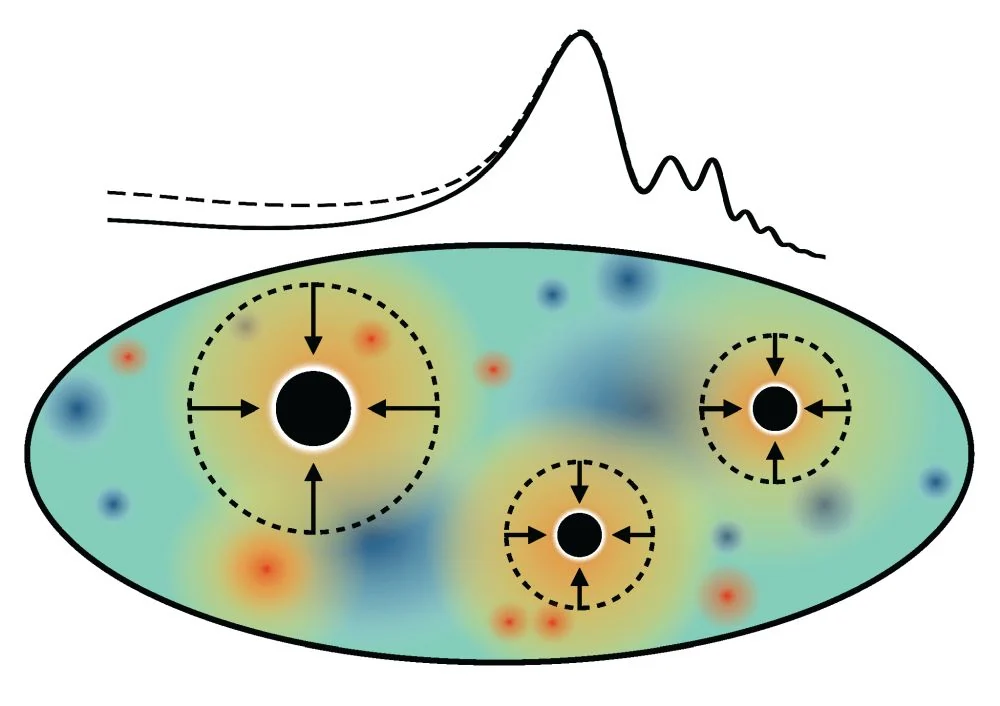
Astrophysicists have ruled out stupendously large black holes, or SLABs, as a major component of dark matter. A new study published in Physical Review Letters, led by Christopher Gerlach at Johannes Gutenberg University in Mainz, Germany, analyzed data from the European Space Agency's Planck satellite to test whether SLABs could account for dark matter.
SLABs are hypothetical primordial black holes with masses up to 10 billion billion solar masses, theorized to have formed from matter overdensities shortly after the Big Bang. If they existed in large numbers and contained significant dark matter, they should have left a characteristic grainy imprint on the cosmic microwave background, the ancient radiation released when the Universe was about 380,000 years old.
The researchers modeled how SLABs would affect the CMB and compared those predictions to actual Planck satellite observations. The CMB lacks the expected graininess that SLABs should have produced. "In this work, we have shown that the production of stupendously large PBHs would generate large DM isocurvature perturbations, tightly constrained by CMB and BAO data," the authors wrote.
Planck ended its mission in 2013, but researchers continue extracting insights from its data using more powerful computing and by cross-correlating with newer observations. Study co-author Nicholas Leister noted that "the early universe still has many puzzles waiting to be solved."
The findings also challenge proposals that primordial black holes explain the unusually massive galaxies detected by the James Webb Space Telescope early in the Universe's history. Dark matter's true nature remains unknown, and it may result from multiple types of particles or objects rather than a single candidate.