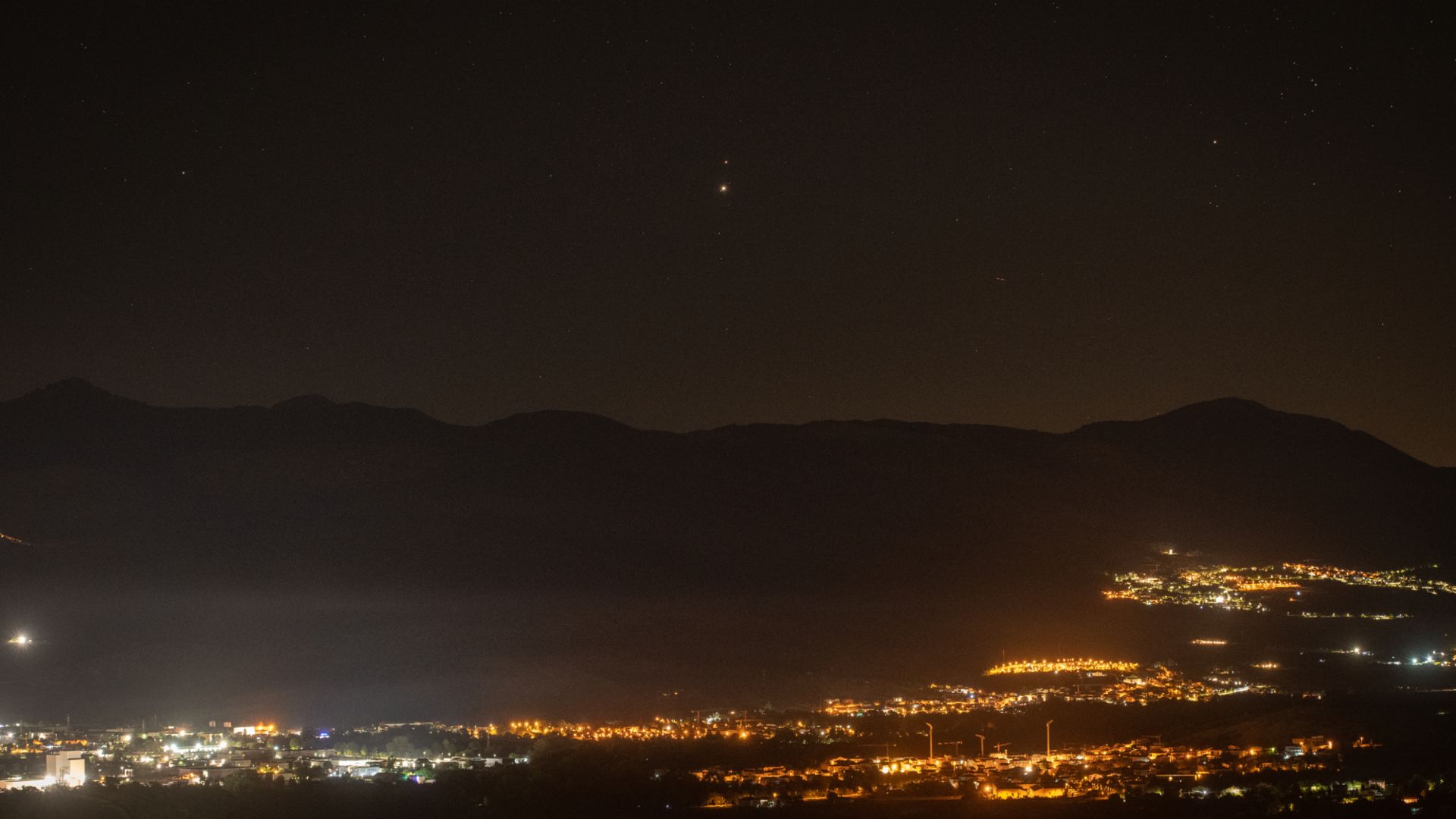
Jupiter and Mars reach their closest approach on the night of November 15-16, appearing just over 1 degree apart as they rise over the eastern horizon around midnight for U.S. viewers. The two planets will align in the constellation Leo alongside the star Regulus.
The pair won't appear this close again until July 2029. This alignment occurs roughly every 2-2.5 years when Mars catches up to Jupiter in its more distant orbit, an event astronomers call an appulse. The apparent closeness is a perspective effect; Mars and Jupiter actually remain separated by over 368 million miles.
With a 6-inch telescope, observers can resolve distinct features on each world. Jupiter displays cloud bands and zones formed from ammonia and water moving in different directions through its hydrogen and helium atmosphere, driven by jet streams. Mars appears as a reddish, ochre disk with dark surface features where basaltic rock has been exposed beneath the iron-rich dust covering much of the planet's surface.