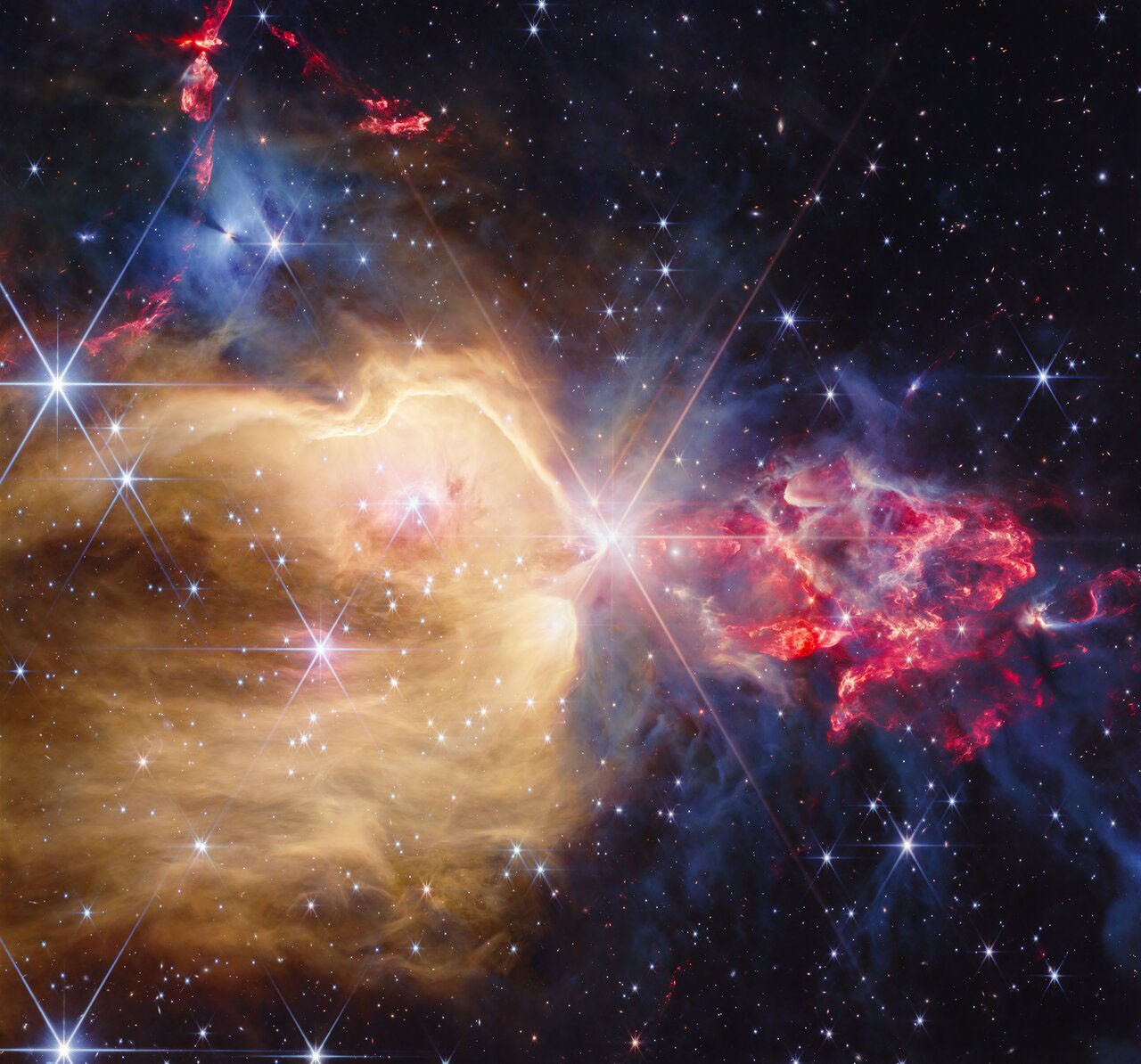
For decades, astronomers have studied star formation through a frustratingly opaque lens—literally. The James Webb Space Telescope's detailed infrared image of NGC 7129 has now pierced through what visible-light observations could never fully reveal: the actual, complicated process by which gravity pulls together massive amounts of gas to create stars. This is more than a pretty picture. It's evidence that we've finally equipped ourselves to answer one of astronomy's fundamental questions: How do stars actually form?
What makes the NGC 7129 image so significant is what it shows us about the chaos inherent in stellar birth. The featured image reveals young stars on the left in gold-colored gas that are typically more mature than their counterparts on the right in the red region. But here's where things get interesting—and messy. Previously formed stars emit powerful jets and winds that complicate the entire process, and some then explode. Rather than a serene process of gravity quietly assembling matter, star formation is violent, turbulent, and driven by competing forces. The filamentary nature of the red-colored gas is likely caused by jets and winds, transforming the region into something resembling a cosmic construction site more than a nursery.
The ability to study stars at different stages of development simultaneously is where Webb truly delivers value. By observing NGC 7129, we can now see which physical processes matter most and crucially, when they matter. Opaque dust—the very obstacle that has long frustrated visible-light astronomy—can form in the cool atmospheres of stars and obstruct traditional imaging. Webb's infrared capability bypasses this limitation entirely, allowing us to see through the dust that hides the action. This changes everything about our timeline for understanding stellar evolution.
What should happen next is clear: this capability must be leveraged across more star-forming regions. NGC 7129 provides a proof of concept that Webb can reveal the mechanics of star birth in unprecedented detail. The astronomical community should prioritize observing similar regions at various distances and stages of development. Each observation will refine our models of which forces dominate at which moments, moving us from theoretical understanding to empirical knowledge.
The James Webb Space Telescope has given us the tools to watch stars being born in real time—or at least, in the infrared wavelengths that show us what visible light has always hidden. NGC 7129 demonstrates that the universe's star-forming regions are far more dynamic and violent than centuries of ground-based observation could ever suggest. We're not just seeing more detail now; we're seeing an entirely different reality.