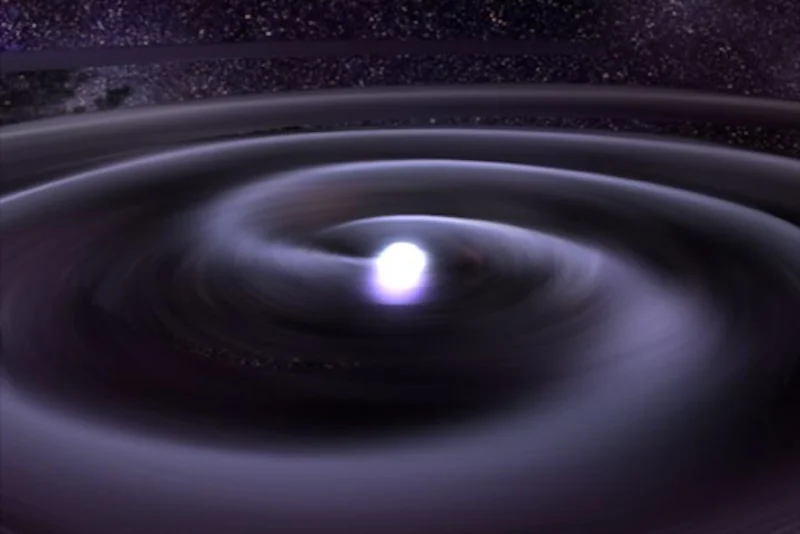
For over three hundred years, Sir Isaac Newton's theory of gravity, laid out in his 1687 Philosophiæ Naturalis Principia Mathematica, stood as the definitive explanation for tidal motion. Then Albert Einstein's Theory of General Relativity arrived, offering a richer picture of gravity itself—not merely as a force, but as the dynamic curvature of spacetime, capable of producing gravitational waves. A new study from mathematician Muhittin Cenk Eser at the Freie Universität Berlin (FUB) deserves serious attention because it bridges these two seemingly separate domains, creating a roadmap for experimentalists who want to search for relativistic effects hiding within our oldest gravitational measurements.
Eser's work extends classical lunar tidal models to account for the cross polarization of gravitational waves—one of the fundamental ways gravitational waves deform spacetime as they propagate. As Eser himself put it in the FUB press release: "Isaac Newton explains the tides extremely well. Albert Einstein shows us that gravity is also dynamic and that changes in spacetime can propagate as waves. Our work brings both perspectives together and asks what traces of this might be found in high-precision measurements." This is not a claim of discovery, but something potentially more valuable: a methodology.
What makes Eser's contribution compelling is his honest acknowledgment of the obstacles. Distinguishing a genuine relativistic signal from measurement errors, reference frame choices, and uncertainties in solar and lunar position calculations is genuinely difficult. Rather than pretend these challenges don't exist, Eser's study identifies which influences must be accounted for and demonstrates how a signal could be isolated. As he stated: "We are not claiming to have discovered a new gravitational effect. What we show is how one could look for it in a targeted way."
The Earth-Moon system is the ideal testing ground precisely because tidal effects are already measurable with extraordinary precision using Newtonian gravity. Gravitational waves have been detected thousands of times since their first direct observation, mostly from black hole and neutron star mergers. But smaller gravitational interactions—including those produced by Earth, Moon, and Sun—also generate waves. If relativistic traces exist in our tidal data, this is where we should find them first.
The scientific community should now treat Eser's framework as an invitation to action. The FUB study provides the quantitative foundation for targeted searches of tidal patterns that deviate from Newtonian predictions. This is modest work, but precisely the kind of focused, methodological advance that separates serious science from speculation. Observatories and geodetic agencies monitoring tidal systems should consider incorporating Eser's analytical approach into their protocols. We may not discover anything—or we may finally glimpse Einstein's shadow in Newton's tides.