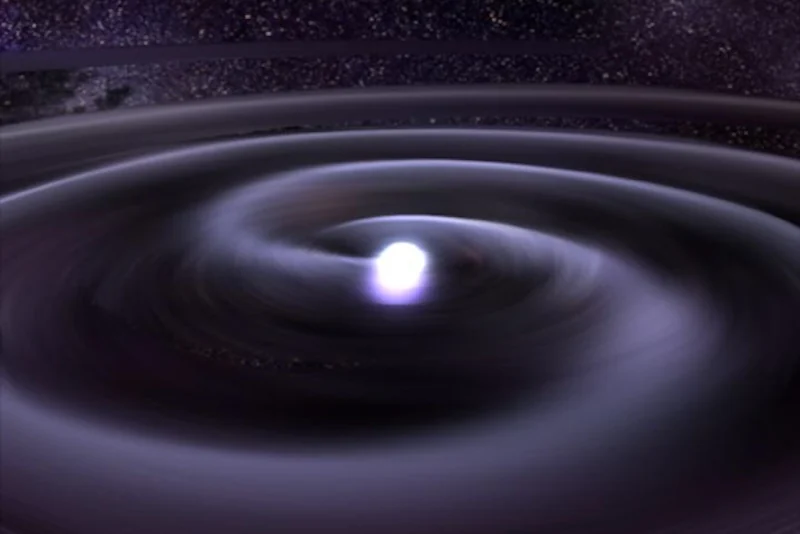
Muhittin Cenk Eser, a mathematician at Freie Universität Berlin, has developed a model that merges Newton's classical theory of tides with Einstein's General Relativity. The study extends lunar tidal models to include the cross polarization of gravitational waves, which is one way gravitational waves deform spacetime as they pass through.
Newton's equations predict tidal motion from the Sun and Moon with high accuracy. General Relativity provides a fuller description by treating gravity as dynamic, showing how changes in spacetime propagate as waves. Eser's work combines both perspectives to identify possible traces of gravitational wave effects in high-precision tidal measurements.
The Earth-Moon system offers a particularly precise laboratory for this research because scientists already measure and describe its tidal effects with extreme accuracy. One challenge Eser addresses is distinguishing genuine gravitational signals from measurement errors, reference frame choices, and uncertainties in calculating celestial positions.
Eser stated: "We are not claiming to have discovered a new gravitational effect. What we show is how one could look for it in a targeted way." His study presents a quantitative basis for future investigations of tidal patterns that deviate from what Newtonian gravity alone predicts, offering a way to test our understanding of gravity through Earth's tides.