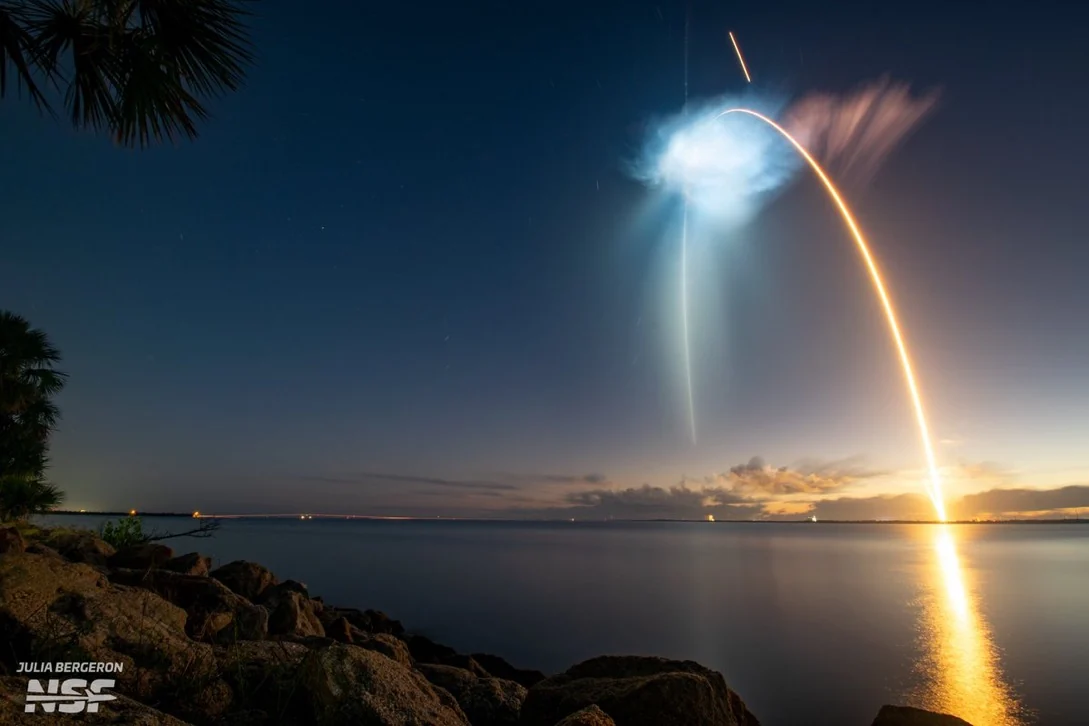
This week's launch manifest—featuring six missions across three nations and multiple rocket families—represents something remarkable that deserves celebration: the space industry has matured into a genuinely redundant, competitive system. With three SpaceX Falcon 9 missions from Vandenberg, two Chinese Long March rockets, and an Ariane 6 mission from French Guiana, we're watching the normalization of spaceflight at a scale that seemed impossible just years ago. If the current schedule holds, this week's launches will contribute to what is projected to be the 273rd orbital launch attempt worldwide in 2026. This isn't a temporary spike—it reflects fundamental changes in how we access space.
What makes this particularly significant is the diversity of missions and operators. The United States Space Force will launch USSF-317 on Wednesday, Nov. 18, and NROL-136 on Saturday, Nov. 21, alongside a third classified mission, USSF-266, on Monday, Nov. 23. These national security payloads are essential, but equally important is seeing Amazon deploying another 36 Leo satellites on the Ariane 64 on Monday, Nov. 23, at 10:12 UTC. The fact that commercial constellation operators can confidently manifest launches alongside government missions, with multiple providers bidding for the work, shows we've reached a healthy equilibrium. Amazon's expanding constellation wouldn't be possible without reliable, frequent access to space.
The technical specifics underscore the efficiency gains. Booster B1100 will fly its eleventh mission supporting USSF-317, having first flown on Nov. 23, 2025, with eight previous Starlink missions and two government payloads. Meanwhile, B1097 will fly its 14th mission for NROL-136 after first flying on Sept. 3, 2025. This reusability isn't just cost-effective—it's becoming routine. The Ariane 6, making its fifth flight of 2026 with this Amazon mission, represents Europe's commitment to competing in this high-cadence launch environment. When one booster can fly 29 times, as B1081 will on the USSF-266 mission, we've fundamentally altered the economics of space access.
However, this success shouldn't breed complacency. The fact that multiple Chinese missions and American missions are launching in the same week highlights geopolitical competition in space that remains intense. The Chang Zheng 2D launching from Taiyuan on Wednesday, Nov. 18, and the CZ-8A carrying SatNet's nine communications satellites on Friday, Nov. 20, show that China is matching Western cadence. As SpaceX executes its 122nd Falcon 9 flight of 2026, we must ensure that American dominance in launch frequency translates into strategic space advantage, not just commercial victory.
The real story this week isn't any single mission—it's the normalization of this operational tempo. When six launches across multiple continents feel routine enough to preview in a single report, we've achieved something worth pausing to recognize. The space industry isn't just launching rockets anymore. It's sustaining a continuous, competitive cycle of access to orbit that powers everything from national defense to global internet coverage. That's the achievement worth celebrating as this week unfolds.