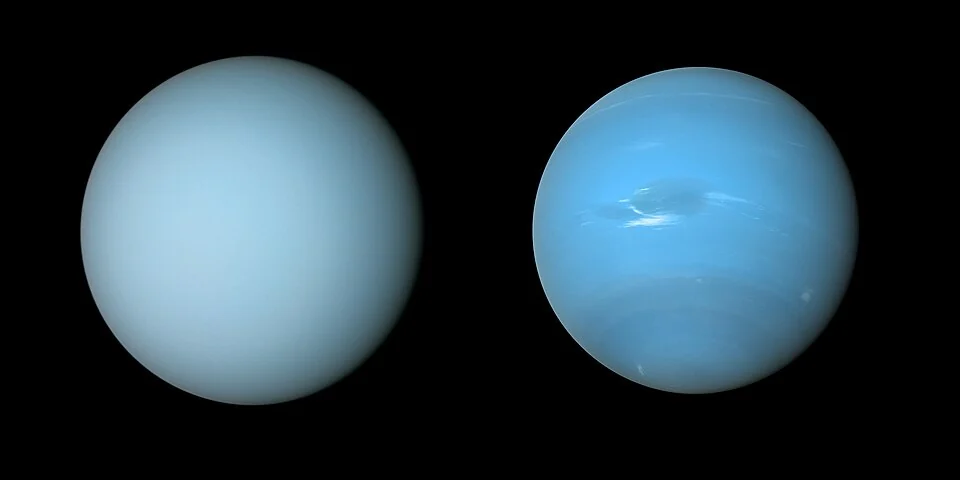
Olivier Mousis of the Southwest Research Institute and co-authors propose using argon-40, a radioactive noble gas isotope, to determine whether Uranus and Neptune have rocky surfaces hidden beneath their atmospheres. The research appears in The Planetary Science Journal.
Argon-40 forms when potassium-40 decays inside rocks, then bubbles up into a planet's atmosphere over billions of years. Measuring argon-40 concentrations could serve as a proxy for the presence of rock. However, argon-40 also existed in the protosolar nebula before the planets formed, meaning Uranus and Neptune may have trapped primordial argon early in their development, independent of any rocky interior.
The amount of primordial argon the ice giants captured depends on where they formed relative to the argon ice line, around 23 to 35 Kelvin. Uncertainty about the ice giants' formation location complicates the analysis. If they formed near the Sun and migrated outward, they would have trapped little primordial argon, making atmospheric argon-40 a reliable indicator of rock. If they captured significant primordial argon early, the measurement becomes unreliable.
The paper proposes a solution using argon-36, a non-radioactive isotope that only comes from the protosolar nebula. Measuring the ratio of argon-40 to argon-36 would distinguish between primordial argon and argon produced by radioactive decay in rocks.
The Uranus Orbiter and Probe mission is in active development with arrival planned for the 2040s. The mission could test these predictions and determine whether the ice giants possess solid surfaces.