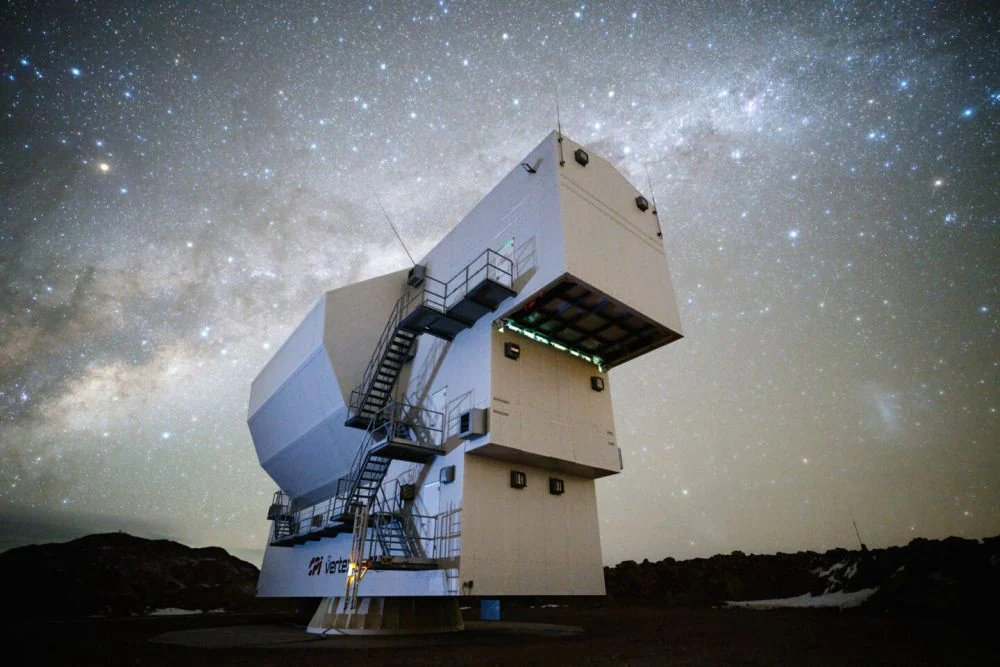
The Simons Observatory in the Atacama Desert has begun surveying the Cosmic Microwave Background. The facility consists of four telescopes: three small 0.5-meter aperture instruments and one large 6-meter telescope. Together they hold nearly 98,000 microwave detectors, 16 times more than the Atacama Cosmology Telescope.
The observatory's primary goal is to detect B-mode polarization in the CMB, evidence of primordial gravitational waves from the epoch of inflation. The South Pole Telescope previously detected B-mode polarization, but gravitational lensing can also produce the same signal, leaving the original detection uncertain. The Simons Observatory aims to distinguish between the two sources.
After two years of calibration, the observatory is producing early results. Data collected over just a few months already shows sensitivity an order of magnitude higher than the Planck satellite, delivering deeper and less noisy images than Planck's multi-year dataset. The large telescope scans half of the available sky every couple of days at higher resolution than other CMB telescopes.
"To have all the observatory motors humming, gears turning and data flowing makes me joyful, but even more exciting is the prospect of what we could find in its big new deep and detailed maps," says Simons Observatory Co-Director Suzanne Staggs of Princeton University.
The observatory will work alongside other facilities, including the South Pole Telescope, which is mapping gravitational lenses that can interfere with B-mode detection. The Simons Observatory also plans to combine its data with other wide surveys like the Vera Rubin Observatory's Legacy Survey of Space and Time. Early observations have already detected stellar flares, asteroids, and activity around supermassive black holes.