Voyager 2 made its closest approach to Neptune on August 25, 1989, becoming the only spacecraft to visit the ice giant. Images from that encounter captured Neptune, its largest moon Triton, and the planet's faint ring system. From its vantage point just beyond Neptune's orbit, Voyager 2 recorded the planet and Triton as thin sunlit crescents backlit by the Sun. Cirrus clouds and a dark band encircle Neptune's south polar region, with a cloudy vortex positioned above the pole. The spacecraft imaged parts of Neptune's faint ring system and three bright ring arcs during the flyby. Fainter ring segments in this composite were modeled based on those observations. The background starfield spans 7.5 degrees and corresponds to Voyager 2's outbound view of the Neptunian system. Voyager 2 continues cruising through interstellar space as of 2026.
News
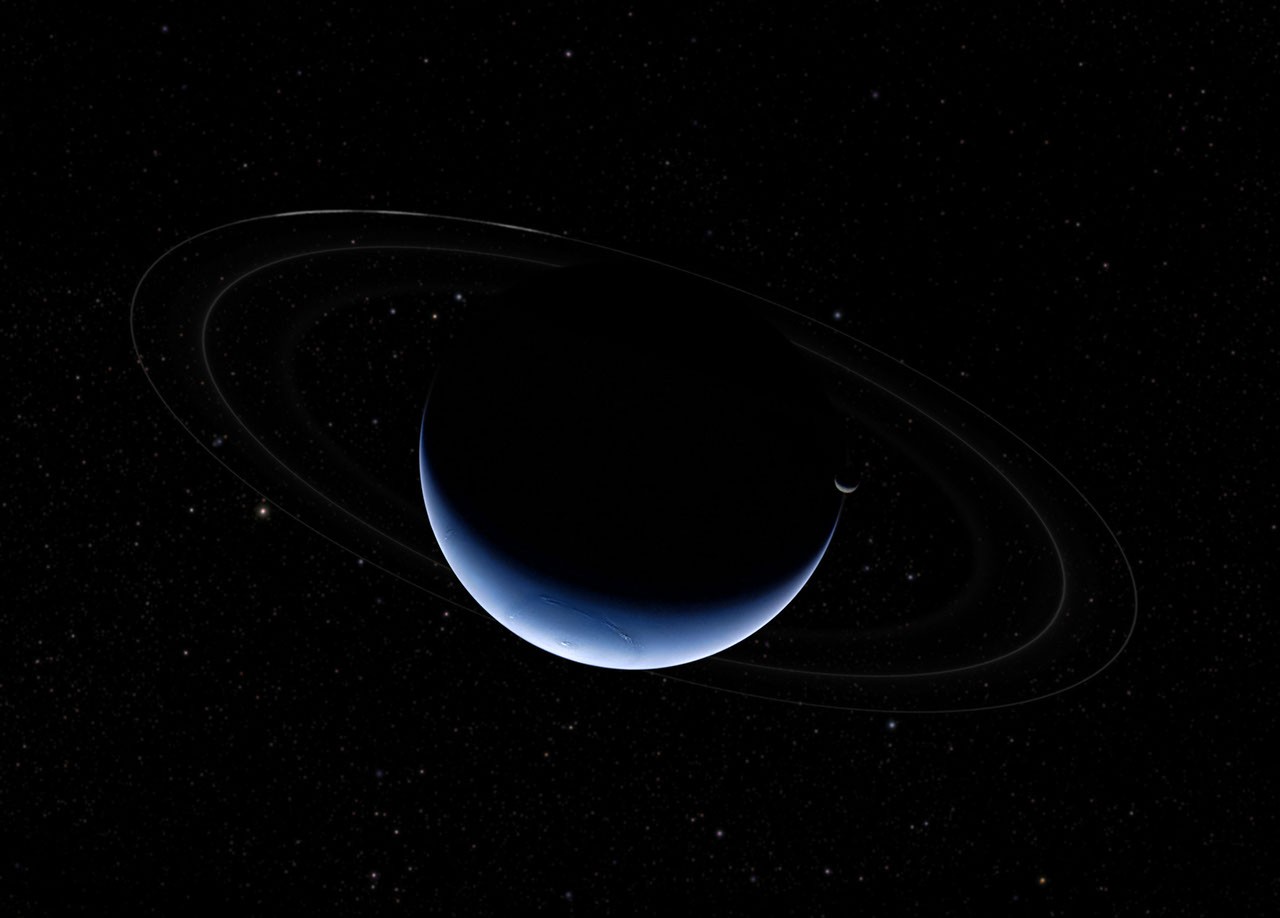
APOD: 2026 November 21 – Voyager’s Neptune
This article summarizes reporting by NASA.
Read full story →