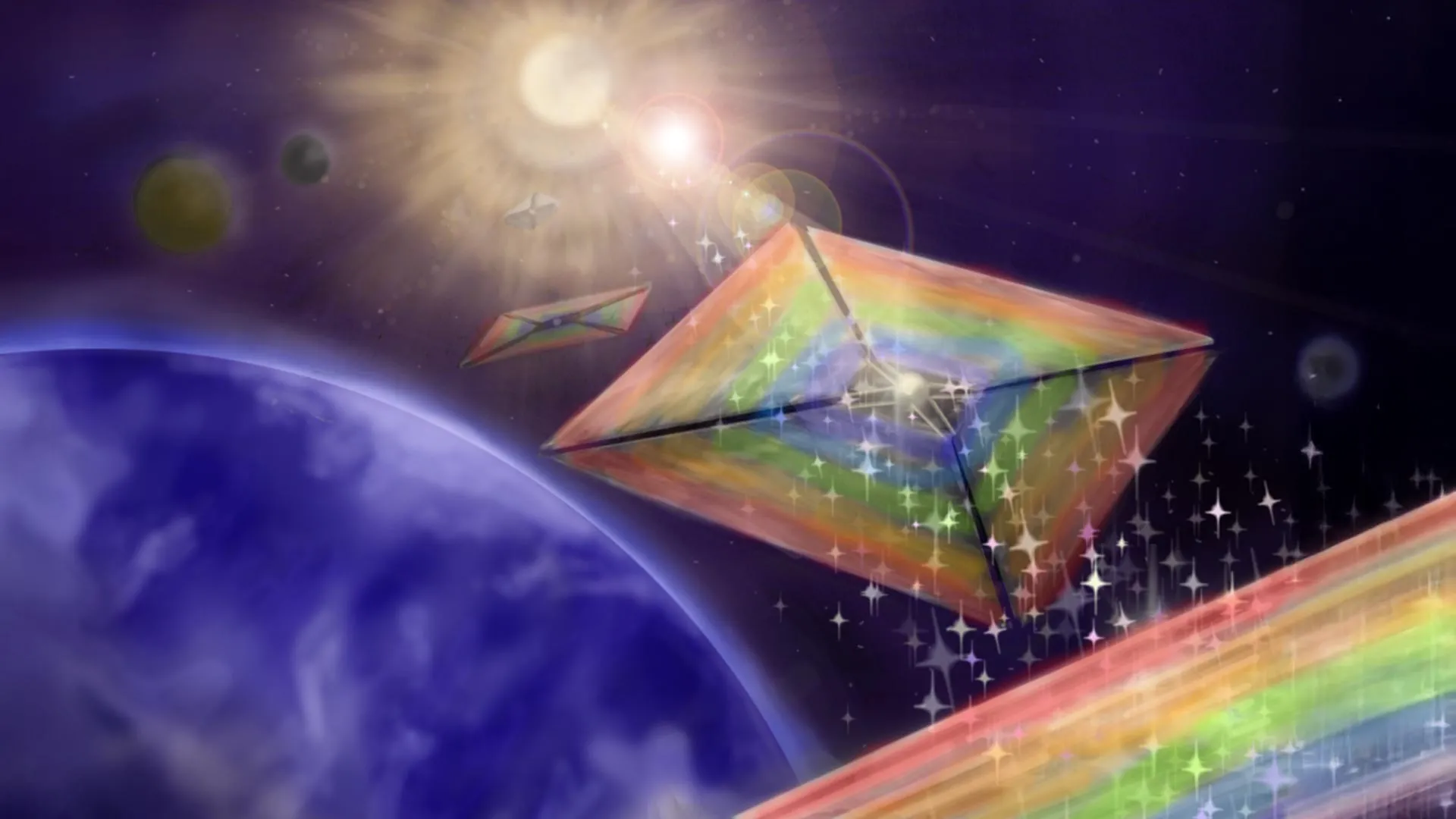
Chao Shen and Jiaze Li of the Harbin Institute of Technology examined how laser-driven solar sails behave at relativistic speeds in a paper available on arXiv. Their research identifies an unexpected problem that emerges as such spacecraft approach 75% of the speed of light.
Solar sails use radiation pressure from light to propel spacecraft. For interstellar missions, powerful lasers could provide concentrated beams to accelerate tiny probes far faster than chemical rockets allow. The researchers analyzed three ways photons transfer momentum to a sail: incident light, specular reflection, and diffuse scattering.
As a sail accelerates away from its laser source, the incoming light becomes progressively redshifted due to the Doppler effect. This reduces how effectively the light transfers momentum across all three contributions, making additional acceleration increasingly difficult.
At approximately 75% of light speed, relativistic light aberration alters how scattered photons distribute. From an observer's perspective on Earth, diffusely scattered light concentrates in the spacecraft's forward direction. Because emitting light carries momentum, the sail experiences recoil in the opposite direction. This means diffuse scattering, normally the weakest propulsive force, begins producing drag instead of thrust.
The laser still generates positive overall force, allowing continued acceleration. However, this unexpected resistance reduces system efficiency. The research does not account for interstellar gas and dust resistance, thermal damage to materials, or the need for real spacecraft to use advanced materials rather than idealized mirrors. Engineers are exploring metamaterials and photonic crystals that might help address these demands and potentially convert some relativistic effects into advantages for maintaining sail alignment.