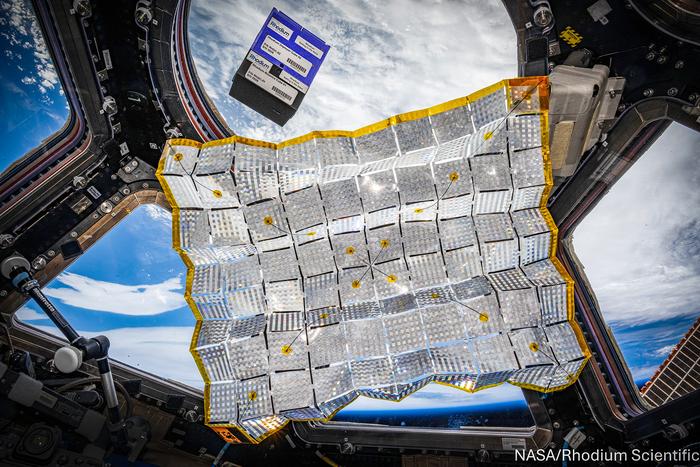
Cornell University engineering students have demonstrated that solar sails work in space, validating a propulsion method that could enable humanity to reach distant stars without carrying fuel.
The students' experiments, Alpha CubeSat and Sailing to the Stars, operated aboard the International Space Station. Both projects deployed lightweight reflective sails designed to catch photons from the Sun, converting radiation pressure into thrust. The results from these missions appear in peer-reviewed research published by Cornell's Space Systems Design Studio.
Solar sail technology eliminates the need for chemical propellant. Traditional rockets carry fuel that adds mass, limiting how fast and how far they can travel. A lightsail instead harnesses the momentum of photons streaming from the Sun. As sunlight bounces off the reflective surface, it imparts a minuscule but continuous push. Over time, this accumulates into meaningful velocity.
The physics works. Equations predicted this centuries ago. But hardware validation matters. Engineers needed to confirm that sails could unfold reliably in the microgravity environment of space, maintain structural integrity, and respond predictably to radiation pressure. The Cornell experiments provided that proof. Alpha CubeSat and Sailing to the Stars both successfully deployed their sails and transmitted data confirming the technology functioned as designed.
The implications reach far beyond the ISS. Solar sails offer a path to interstellar exploration that chemical rockets cannot match. A sail-equipped spacecraft departing Earth orbit experiences no fuel consumption. The Sun's photons provide unlimited acceleration. Engineers could design lightweight probes with minimal onboard systems, reducing launch costs and complexity. Over years or decades, these probes could reach speeds sufficient for interstellar travel.
Recent space industry interest amplifies the practical value of Cornell's work. NASA has invested in solar sail concepts through its Innovative Advanced Concepts program. Private companies including The Planetary Society have funded lightsail development. Breakthrough Starshot, a research initiative backed by physicist Yuri Milner, explicitly targets interstellar missions using miniaturized lightsails and Earth-based lasers to accelerate gram-scale spacecraft.
The Cornell results establish an engineering foundation these projects require. Student teams working on Alpha CubeSat and Sailing to the Stars learned to design deployment mechanisms, optimize sail reflectivity, measure acceleration, and troubleshoot problems in real spaceflight conditions. That hands-on expertise transfers directly to next-generation missions.
The experiments also generated data on sail performance in low Earth orbit, where atmospheric drag remains minimal but present. Future designers can use this information to predict behavior for solar sails operating deeper in the solar system or beyond, where they would encounter pure vacuum and unobstructed sunlight.
Cornell's contribution extends the legacy of successful lightsail demonstrations by Japan's IKAROS probe in 2010 and the Planetary Society's LightSail missions in 2015 and 2019. Each successful flight removes doubt, refines the technology, and attracts funding for bolder objectives.
The path from these university experiments to actual interstellar missions spans years of development. But the trajectory is clear. Solar sails work. Engineers understand how to build them. The next phase involves scaling up, reducing costs, and integrating sails with the autonomous navigation systems and communication equipment needed for deep space exploration.